

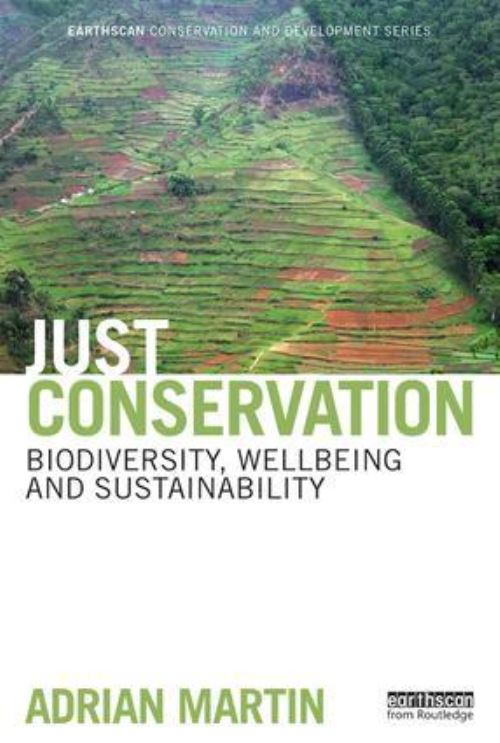
Loss of biodiversity is one of the great environmental challenges facing humanity but unfortunately efforts to reduce the rate of loss have so far failed. At the same time, these efforts have too often resulted in unjust social outcomes in which people living in or near to areas designated for conservation lose access to their territories and resources. In this book the author argues that our approach to biodiversity conservation needs to be more strongly informed by a concern for and understanding of social justice issues.
Injustice can be a driver of biodiversity loss and a barrier to efforts at preservation. Conversely, the pursuit of social justice can be a strong motivation to find solutions to environmental problems. The book therefore argues that the pursuit of socially just conservation is not only intrinsically the right thing to do, but will also be instrumental in bringing about greater success.
The argument for a more socially just conservation is initially developed conceptually, drawing upon ideas of environmental justice that incorporate concerns for distribution, procedure and recognition. It is then applied to a range of approaches to conservation including benefit sharing arrangements, integrated conservation and development projects and market-based approaches such as sustainable timber certification and payments for ecosystem services schemes. Case studies are drawn from the author's research in Rwanda, Uganda, Tanzania, Laos, Bolivia, China and India.
| ISBN: | 9781138788596 |
| Publication date: | 4th May 2017 |
| Author: | Adrian Martin |
| Publisher: | Routledge an imprint of Taylor & Francis |
| Format: | Paperback |
| Pagination: | 200 pages |
| Series: | Earthscan Conservation and Development Series |
| Genres: |
Biodiversity Public international law: human rights Environment law Ethics and moral philosophy Human geography Regional geography Botany and plant sciences Development studies Sociology Anthropology Environmental policy and protocols Environmental management Conservation of the environment |
Loss of biodiversity is one of the great environmental challenges facing humanity but unfortunately efforts to reduce the rate of loss have so far failed. At the same time, these efforts have too often resulted in unjust social outcomes in which people living in or near to areas designated for conservation lose access to their territories and resources.
Just Conservation features in the following genres: Biodiversity, Public international law: human rights, Environment law, Ethics and moral philosophy, Human geography, Regional geography, Botany and plant sciences, Development studies, Sociology, Anthropology, Environmental policy and protocols, Environmental management, Conservation of the environment
Hardback, Paperback, Ebook. £44.09, down from the £48.99 cover price. Not Available.
Just Conservation was written by Adrian Martin and published by Routledge an imprint of Taylor & Francis
Just Conservation has 200 pages
Yes it is part of Earthscan Conservation and Development Series series
£44.09, reduced from £48.99. Not Available.