

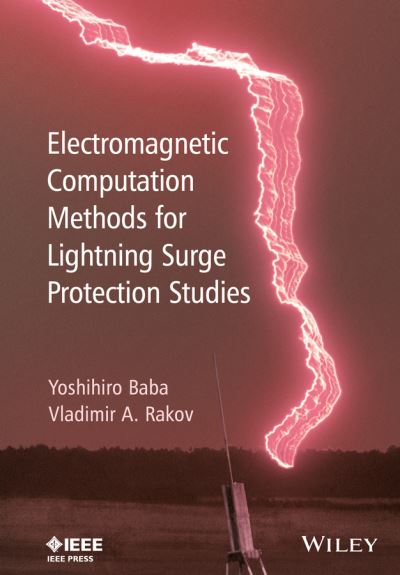
Presents current research into electromagnetic computation theories with particular emphasis on Finite-Difference Time-Domain Method
This book is the first to consolidate current research and to examine the theories of electromagnetic computation methods in relation to lightning surge protection. The authors introduce and compare existing electromagnetic computation methods such as the method of moments (MOM), the partial element equivalent circuit (PEEC), the finite element method (FEM), the transmission-line modeling (TLM) method, and the finite-difference time-domain (FDTD) method.
The application of FDTD method to lightning protection studies is a topic that has matured through many practical applications in the past decade, and the authors explain the derivation of Maxwell's equations required by the FDTD, and modeling of various electrical components needed in computing lightning electromagnetic fields and surges with the FDTD method.
The book describes the application of FDTD method to current and emerging problems of lightning surge protection of continuously more complex installations, particularly in critical infrastructures of energy and information, such as overhead power lines, air-insulated sub-stations, wind turbine generator towers and telecommunication towers.
| ISBN: | 9781118275634 |
| Publication date: | 26th April 2016 |
| Author: | Yoshihiro Baba, Vladimir A Rakov |
| Publisher: | Wiley-IEEE Press an imprint of Wiley |
| Format: | Hardback |
| Pagination: | 320 pages |
| Series: | IEEE Press |
| Genres: |
Electronics and communications engineering |
Presents current research into electromagnetic computation theories with particular emphasis on Finite-Difference Time-Domain Method This book is the first to consolidate current research and to examine the theories of electromagnetic computation methods in relation to lightning surge protection. The authors introduce and compare existing electromagnetic computation methods such as the method of moments (MOM), the partial element equivalent circuit (PEEC), the finite element method (FEM), the transmission-line modeling (TLM) method, and the finite-difference time-domain (FDTD) method. The application of FDTD method to lightning protection studies is a topic that has matured through many practical applications in the past decade, and the authors explain the derivation of Maxwell's equations required by the FDTD, and modeling of various electrical components needed in computing lightning electromagnetic fields and surges with the FDTD method. The book describes the application of FDTD method to current and emerging problems of lightning surge protection of continuously more complex installations, particularly in critical infrastructures of energy and information, such as overhead power lines, air-insulated sub-stations, wind turbine generator towers and telecommunication towers. Both authors are internationally recognized experts in the area of lightning study and this is the first book to present current research in lightning surge protection Examines in detail why lightning surges occur and what can be done to protect against them Includes theories of electromagnetic computation methods and many examples of their application Accompanied by a sample printed program based on the finite-difference time-domain (FDTD) method written in C++ program
Electromagnetic Computation Methods for Lightning Surge Protection Studies features in the following genres: Electronics and communications engineering
Hardback. £114.26, down from the £126.95 cover price. Not Available.
Electromagnetic Computation Methods for Lightning Surge Protection Studies was written by Yoshihiro Baba, Vladimir A Rakov and published by Wiley-IEEE Press an imprint of Wiley
Electromagnetic Computation Methods for Lightning Surge Protection Studies has 320 pages
Yes it is part of IEEE Press series
£114.26, reduced from £126.95. Not Available.