

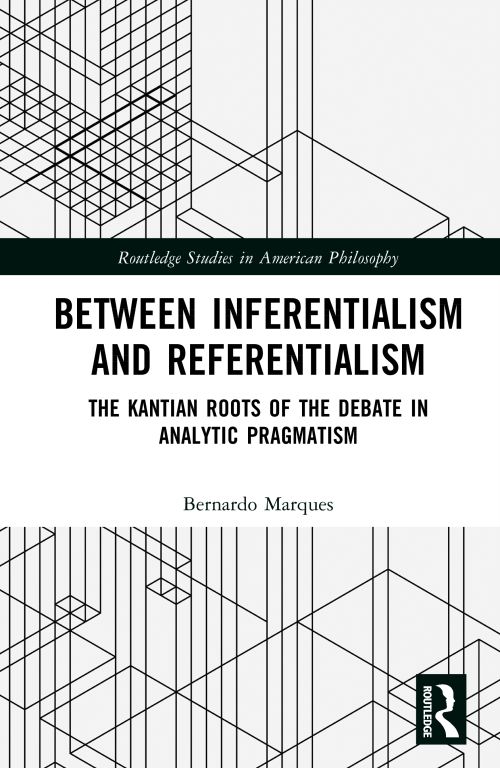
This book explores the enduring opposition between two competing theories of meaning-referentialism and inferentialism-within the pragmatist tradition. It explores the historical and philosophical underpinnings of this debate, tracing its roots to Kant's principle of togetherness, which emphasizes the interplay between concepts and intuitions as the foundation of cognition.
The book offers a comprehensive reconstruction of inferentialism, examining its evolution from Carnap's syntactic project to Sellars's critique of the Given and Brandom's normative pragmatics. The author argues that inferentialism, while innovative, ultimately fails to maintain the Kantian balance between language and the world. In contrast, he advances a pragmatist referentialism, drawing on Peirce's semiotic innovations and François Recanati's radical contextualism to propose a theory of meaning that integrates empirical and rational dimensions.
By situating the inferentialist-referentialist divide within pragmatism and connecting it to broader developments in analytic philosophy, logic, and Kantian thought, Between Inferentialism and Referentialism reframes contemporary debates on semantics. It is an essential resource for scholars and students of pragmatism, philosophy of language, and the history of analytic philosophy.
| ISBN: | 9781041315896 |
| Publication date: | 3rd December 2026 |
| Author: | Bernardo Marques |
| Publisher: | Routledge an imprint of Taylor & Francis |
| Format: | Hardback |
| Pagination: | 256 pages |
| Series: | Routledge Studies in American Philosophy |
| Genres: |
Philosophy of language Western philosophy: Enlightenment Western philosophy from c 1800 Philosophy: epistemology and theory of knowledge Philosophy of mind Semantics, discourse analysis, stylistics |
This book explores the enduring opposition between two competing theories of meaning-referentialism and inferentialism-within the pragmatist tradition. It explores the historical and philosophical underpinnings of this debate, tracing its roots to Kant's principle of togetherness, which emphasizes the interplay between concepts and intuitions as the foundation of cognition.The book offers a comprehensive reconstruction of inferentialism, examining its evolution from Carnap's syntactic project to Sellars's critique of the Given and Brandom's normative pragmatics.
Between Inferentialism and Referentialism features in the following genres: Philosophy of language, Western philosophy: Enlightenment, Western philosophy from c 1800, Philosophy: epistemology and theory of knowledge, Philosophy of mind, Semantics, discourse analysis, stylistics
Hardback. £154.79, down from the £171.99 cover price. Not Available.
Between Inferentialism and Referentialism was written by Bernardo Marques and published by Routledge an imprint of Taylor & Francis
Between Inferentialism and Referentialism has 256 pages
Yes it is part of Routledge Studies in American Philosophy series
£154.79, reduced from £171.99. Not Available.