

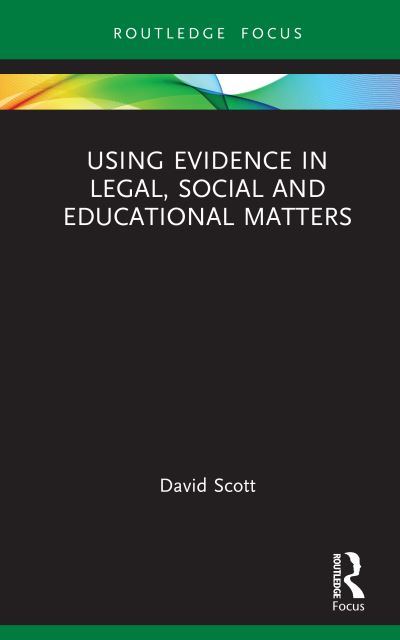
Evidence as a concept is central to our understanding of the world and the way in which we establish or verify the truth or otherwise of a statement, assertion or proposition. This interdisciplinary book focuses on the multiple and sometimes complex meanings that can be attached to the idea of evidence and its relationship to knowledge, learning and educational research.
By exploring some of the key issues in the field of educational research, this title allows the reader to understand what evidence is and why it is important while also questioning the gatekeepers of evidence and the power they have in terms of use and control. Chapters unpack the ways that several prominent organisations use evidence in their work, including the Programme for International Student Assessment (PISA), the Education Endowment Foundation (EEF) and the BBC, among others.
A thought-provoking analysis of the field, this is an essential read for all those looking to develop an understanding of evidence and the ways it can be used in educational settings as well as researchers and postgraduate students in the field of educational research.
| ISBN: | 9781041207535 |
| Publication date: | 1st May 2026 |
| Author: | David Scott |
| Publisher: | Routledge an imprint of Taylor & Francis |
| Format: | Hardback |
| Pagination: | 144 pages |
| Series: | Qualitative and Visual Methodologies in Educational Research |
| Genres: |
Educational strategies and policy Social research and statistics Educational systems and structures Interdisciplinary studies |
Evidence as a concept is central to our understanding of the world and the way in which we establish or verify the truth or otherwise of a statement, assertion or proposition. This interdisciplinary book focuses on the multiple and sometimes complex meanings that can be attached to the idea of evidence and its relationship to knowledge, learning and educational research.By exploring some of the key issues in the field of educational research, this title allows the reader to understand what evidence is and why it is important while also questioning the gatekeepers of evidence and the power they have in terms of use and control.
Using Evidence in Legal, Social and Educational Matters features in the following genres: Educational strategies and policy, Social research and statistics, Educational systems and structures, Interdisciplinary studies
Hardback. £47.69, down from the £52.99 cover price. Not Available.
Using Evidence in Legal, Social and Educational Matters was written by David Scott and published by Routledge an imprint of Taylor & Francis
Using Evidence in Legal, Social and Educational Matters has 144 pages
Yes it is part of Qualitative and Visual Methodologies in Educational Research series
£47.69, reduced from £52.99. Not Available.