

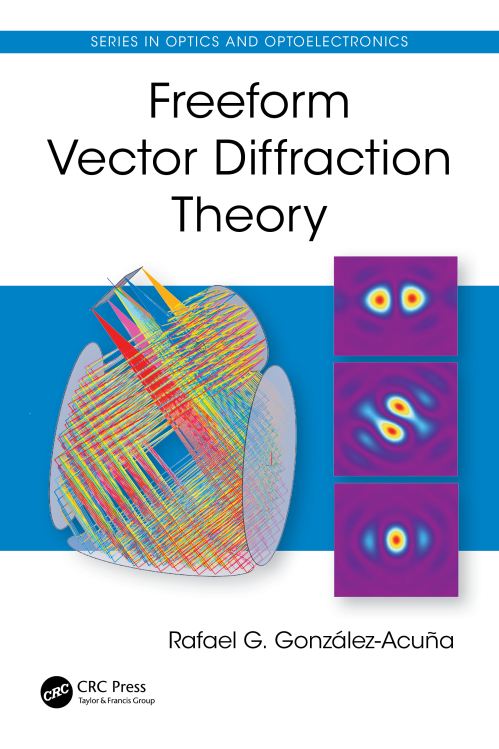
Freeform Vector Diffraction Theory traces the conceptual journey from classical scalar diffraction to a rigorous and generalized framework for computing the vector diffraction patterns of arbitrary freeform wavefronts and complex, spatially varying polarization states.
Readers will gain a unified theoretical perspective that enables accurate prediction of electromagnetic field behavior in high-numerical-aperture systems and modern non-conventional optics. The book delivers these fundamental insights through detailed mathematical and geometrical toolkits, including vector calculus and Zernike polynomials, which facilitate rigorous derivations of the generalized Richards-Wolf integrals in both cylindrical and Cartesian coordinates.
It also explores key practical applications in fields such as super-resolution microscopy, advanced lithography, and optical trapping. Through in-depth analysis of apodization functions and the response of radially, azimuthally, and linearly polarized light, readers will learn to precisely characterize complex optical systems affected by significant aberrations.
This work is an indispensable resource for leading researchers, optical design engineers, and graduate students in optics and photonics who seek to accurately model non-stigmatic and aberrated systems. The text clearly sets itself apart from other treatises on the subject by moving beyond the classical assumptions of spherical and ideal wavefronts typical of traditional theories.
Instead, it offers a robust analytical framework for freeform surfaces and complex vectorial beams encountered in today's technology. By masterfully integrating concepts such as the Malus-Dupin theorem and the angular spectrum representation, the book equips professionals with the essential tools to analyze the vector nature of light and optimize optical instruments in an era where structured light continues to reveal profound new insights into the electromagnetic nature of radiation.
| ISBN: | 9781041201984 |
| Publication date: | 2nd October 2026 |
| Author: | Rafael G GonzálezAcuña |
| Publisher: | CRC Press |
| Format: | Hardback |
| Pagination: | 286 pages |
| Series: | Series in Optics and Optoelectronics |
| Genres: |
Optical physics Applied optics |
Freeform Vector Diffraction Theory traces the conceptual journey from classical scalar diffraction to a rigorous and generalized framework for computing the vector diffraction patterns of arbitrary freeform wavefronts and complex, spatially varying polarization states.Readers will gain a unified theoretical perspective that enables accurate prediction of electromagnetic field behavior in high-numerical-aperture systems and modern non-conventional optics. The book delivers these fundamental insights through detailed mathematical and geometrical toolkits, including vector calculus and Zernike polynomials, which facilitate rigorous derivations of the generalized Richards-Wolf integrals in both cylindrical and Cartesian coordinates.
Freeform Vector Diffraction Theory features in the following genres: Optical physics, Applied optics
Hardback. £112.49, down from the £124.99 cover price. Not Available.
Freeform Vector Diffraction Theory was written by Rafael G GonzálezAcuña and published by CRC Press
Freeform Vector Diffraction Theory has 286 pages
Yes it is part of Series in Optics and Optoelectronics series
£112.49, reduced from £124.99. Not Available.