

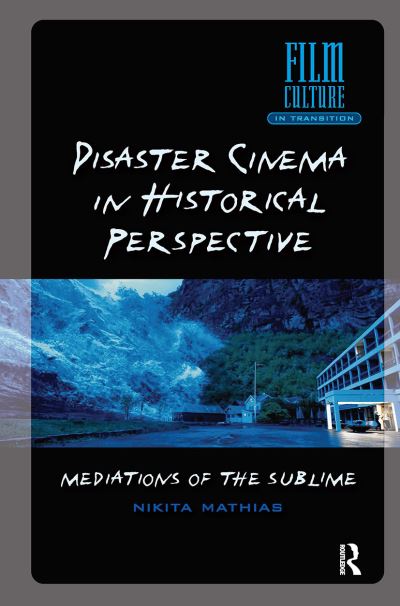
How do we experience disaster films in cinema? And where does disaster cinema come from? The two questions are more closely related than one might initially think.
For the framework of the cinematic experience of natural disasters has its roots in the mid-eighteenth century when the aesthetic category of the sublime was re-established as the primary mode for appreciating nature's violent forces. In this book, the sublime is understood as a complex and culturally specific meeting point between philosophical thought, artistic creation, social and technical development, and popular imagination.
On the one hand, the sublime provides a receptive model to uncover how cinematic disaster depictions affect our senses, bodies and minds. On the other hand, this experiential framework of disaster cinema is only one of the most recent agents within the historical trajectory of sublime disasters, which is traced in this book among a broad range of media: from landscape and history painting to a variety of pictorial devices like Eidophusikon, Panorama, Diorama, and, finally, cinema.
| ISBN: | 9781041178217 |
| Publication date: | 1st December 2025 |
| Author: | Nikita Mathias |
| Publisher: | Routledge an imprint of Taylor & Francis |
| Format: | Paperback |
| Pagination: | 356 pages |
| Series: | Film Culture in Transition |
| Genres: |
Film history, theory or criticism Philosophy: aesthetics History of art |
How do we experience disaster films in cinema? And where does disaster cinema come from?
Disaster Cinema in Historical Perspective features in the following genres: Film history, theory or criticism, Philosophy: aesthetics, History of art
Paperback, Hardback. £43.19, down from the £47.99 cover price. Not Available.
Disaster Cinema in Historical Perspective was written by Nikita Mathias and published by Routledge an imprint of Taylor & Francis
Disaster Cinema in Historical Perspective has 356 pages
Yes it is part of Film Culture in Transition series
£43.19, reduced from £47.99. Not Available.