

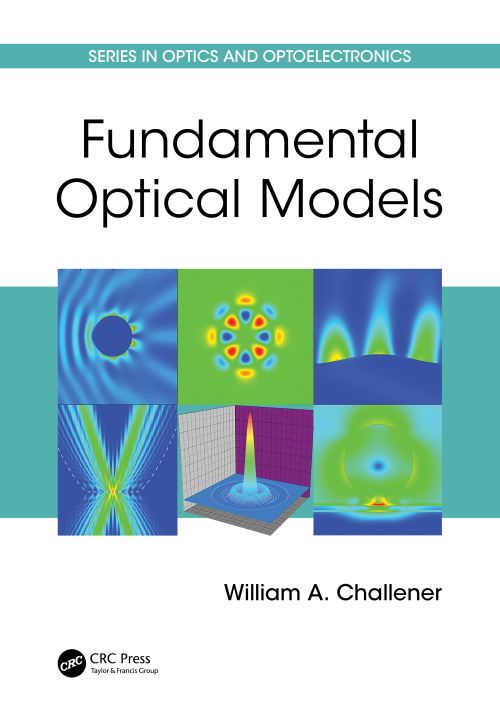
Fundamental Optical Models addresses the theory of several fundamental optical problems and provides insights into converting theory into computer software. The book brings together a variety of essential theories and modeling tools - some only found in very old research papers - into a single text and helps researchers to understand the theories needed to develop their own software that can be customized for different projects. The book's nine chapters cover the optics of multilayer thin films, planar waveguides, multilayer conformal thin films on diffraction gratings, the method of lines for modeling more general waveguides, cylindrical waveguides (i.e. optical fibers) with multilayers, fields in the vicinity of the focus of a lens, near field-to-far field transforms, and scattered field finite difference time domain modeling. To aid learning, the book includes a large number of examples and helpful hints in converting theory into computer algorithms.
This book is suitable for undergraduate and graduate students studying electromagnetism and optics, as well as industrial researchers.
Key Features:
| ISBN: | 9781041148364 |
| Publication date: | 21st August 2026 |
| Author: | William Albert Challener |
| Publisher: | CRC Press |
| Format: | Hardback |
| Pagination: | 448 pages |
| Series: | Series in Optics and Optoelectronics |
| Genres: |
Optical physics Mathematical physics Computer modelling and simulation |
Fundamental Optical Models addresses the theory of several fundamental optical problems and provides insights into converting theory into computer software. The book brings together a variety of essential theories and modeling tools - some only found in very old research papers - into a single text and helps researchers to understand the theories needed to develop their own software that can be customized for different projects.
Fundamental Optical Models features in the following genres: Optical physics, Mathematical physics, Computer modelling and simulation
Hardback. £131.39, down from the £145.99 cover price. Not Available.
Fundamental Optical Models was written by William Albert Challener and published by CRC Press
Fundamental Optical Models has 448 pages
Yes it is part of Series in Optics and Optoelectronics series
£131.39, reduced from £145.99. Not Available.