

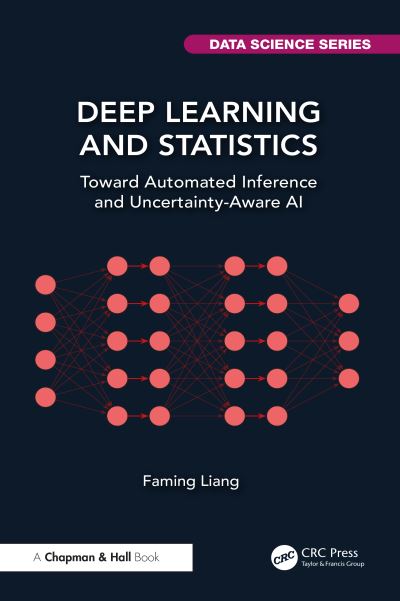
Deep Learning and Statistics: Toward Automated Inference and Uncertainty-Aware AI presents modern deep learning through a statistical lens, emphasizing theoretical foundations and methodologies for automated inference and uncertainty-aware AI. The book begins with foundational material on neural network architectures, representation power, stochastic optimization, and Monte Carlo methods. It then develops two complementary directions-"deep learning for statistics" and "statistics for deep learning"-covering topics such as sparse deep learning, stochastic deep learning, extended fiducial inference, deep generative modelling, and deep reinforcement learning.
The book is guided by the view that statistical principles can deepen our understanding of deep learning and support its further development. In particular, sparse learning, stochastic modelling, and extended fiducial inference offer complementary tools for making deep learning models more interpretable, uncertainty-aware, and practically useful in modern data science. Conversely, deep neural networks serve as flexible approximators of unknown data-generating mechanisms, enabling new approaches to classical statistical inference problems, including nonlinear variable selection, sufficient dimension reduction, and causal inference in general settings.
A distinctive feature of the book is its development of extended fiducial inference as a new paradigm for statistical inference, in which inference is formulated as the problem of solving data-generating equations. Extended fiducial inference uses deep neural networks to approximate parameter inverse mappings and adaptive stochastic-gradient Markov chain Monte Carlo to simulate latent random errors.
Through a push-forward mechanism, the uncertainty embedded in the observations is then propagated to model parameters and predictions. This framework generalizes R. A. Fisher's fiducial insights to broader classes of statistical problems and provides a concrete step toward automated statistical inference and uncertainty-aware AI.
The book is intended for researchers in machine learning and statistics, data scientists interested in modern deep learning methodology, and graduate students in statistics, biostatistics, and related data science disciplines. It can also serve as a textbook for special-topics graduate courses focused on the interaction between deep learning and statistics.
Key Features
| ISBN: | 9781041111658 |
| Publication date: | 24th December 2026 |
| Author: | F Liang |
| Publisher: | Chapman & Hall/CRC an imprint of CRC Press |
| Format: | Hardback |
| Pagination: | 488 pages |
| Series: | Chapman & Hall/CRC Data Science Series |
| Genres: |
Probability and statistics Automatic control engineering |
Deep Learning and Statistics: Toward Automated Inference and Uncertainty-Aware AI presents modern deep learning through a statistical lens, emphasizing theoretical foundations and methodologies for automated inference and uncertainty-aware AI. The book begins with foundational material on neural network architectures, representation power, stochastic optimization, and Monte Carlo methods.
Deep Learning and Statistics features in the following genres: Probability and statistics, Automatic control engineering
Hardback. £93.59, down from the £103.99 cover price. Not Available.
Deep Learning and Statistics was written by F Liang and published by Chapman & Hall/CRC an imprint of CRC Press
Deep Learning and Statistics has 488 pages
Yes it is part of Chapman & Hall/CRC Data Science Series series
£93.59, reduced from £103.99. Not Available.