

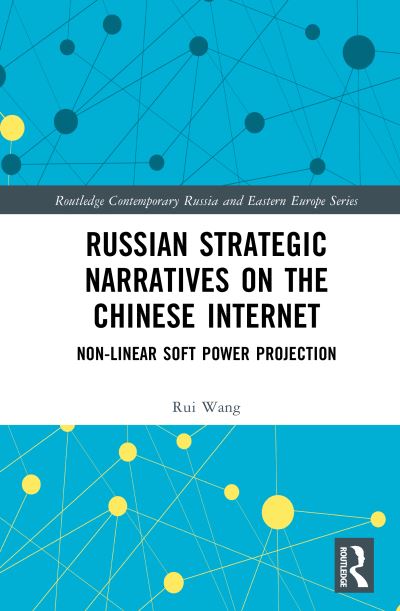
This book challenges the notion that strategic narratives, which carry soft power significance, are seamlessly projected to audiences. It offers the first book-length critical analysis of the non-linear dissemination of strategic narratives in the digital age, focusing on social media.
Through a case study of a Chinese state-aligned outlet's mediation of Russian broadcaster RT's videos and their remediation by Chinese social media users' danmu comments on Bilibili, it reveals disruptions by participatory media agents, including outlets and audiences. These multilayered mediations, driven by political and commercial agendas or online practices, yield unexpected benefits and challenges for narrative producers.
The book's main argument is that state actors have little control over the dissemination of the strategic narratives they project in the digital age. The dissemination paths of these narratives are non-linear and involve multilayered mediations imposed by other political actors for their own political and commercial agendas, as well as mediations introduced by participatory audiences who impose their own online practices, conventions, and rituals onto the narratives.
A major intervention in the study of soft power projection through public diplomacy in the online era and the emerging geopolitical alliance between Russia and China, this interdisciplinary book will be of interest to researchers in the fields of Media Studies, Russia-China relations, Political Communication, Digital Culture, and Studies of Russian politics and Chinese politics.
| ISBN: | 9781032993560 |
| Publication date: | 31st December 2025 |
| Author: | Rui Wang |
| Publisher: | Routledge an imprint of Taylor & Francis |
| Format: | Hardback |
| Pagination: | 234 pages |
| Series: | Routledge Contemporary Russia and Eastern Europe Series |
| Genres: |
International relations Political campaigning and advertising Regional / International studies |
This book challenges the notion that strategic narratives, which carry soft power significance, are seamlessly projected to audiences. It offers the first book-length critical analysis of the non-linear dissemination of strategic narratives in the digital age, focusing on social media.Through a case study of a Chinese state-aligned outlet's mediation of Russian broadcaster RT's videos and their remediation by Chinese social media users' danmu comments on Bilibili, it reveals disruptions by participatory media agents, including outlets and audiences.
Russian Strategic Narratives on the Chinese Internet features in the following genres: International relations, Political campaigning and advertising, Regional / International studies
Hardback. £154.79, down from the £171.99 cover price. Not Available.
Russian Strategic Narratives on the Chinese Internet was written by Rui Wang and published by Routledge an imprint of Taylor & Francis
Russian Strategic Narratives on the Chinese Internet has 234 pages
Yes it is part of Routledge Contemporary Russia and Eastern Europe Series series
£154.79, reduced from £171.99. Not Available.