

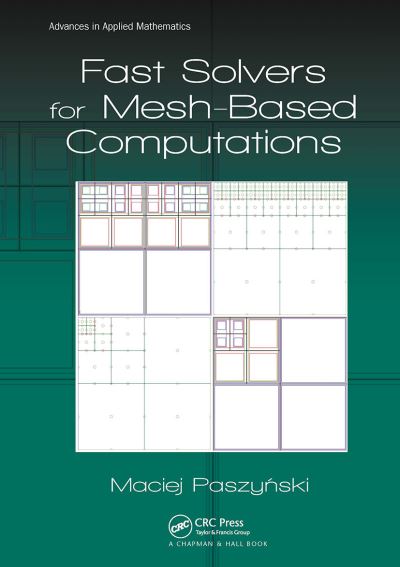
Fast Solvers for Mesh-Based Computations presents an alternative way of constructing multi-frontal direct solver algorithms for mesh-based computations. It also describes how to design and implement those algorithms.The book's structure follows those of the matrices, starting from tri-diagonal matrices resulting from one-dimensional mesh-based methods, through multi-diagonal or block-diagonal matrices, and ending with general sparse matrices.Each chapter explains how to design and implement a parallel sparse direct solver specific for a particular structure of the matrix.
All the solvers presented are either designed from scratch or based on previously designed and implemented solvers.Each chapter also derives the complete JAVA or Fortran code of the parallel sparse direct solver. The exemplary JAVA codes can be used as reference for designing parallel direct solvers in more efficient languages for specific architectures of parallel machines.The author also derives exemplary element frontal matrices for different one-, two-, or three-dimensional mesh-based computations.
These matrices can be used as references for testing the developed parallel direct solvers.Based on more than 10 years of the author's experience in the area, this book is a valuable resource for researchers and graduate students who would like to learn how to design and implement parallel direct solvers for mesh-based computations.
| ISBN: | 9781032921440 |
| Publication date: | 14th October 2024 |
| Author: | Maciej Paszynski |
| Publisher: | CRC Press |
| Format: | Paperback |
| Pagination: | 352 pages |
| Series: | Advances in Applied Mathematics |
| Genres: |
Computer science Algorithms and data structures Information technology: general topics Mathematics Technology, Engineering, Agriculture, Industrial processes |
Fast Solvers for Mesh-Based Computations presents an alternative way of constructing multi-frontal direct solver algorithms for mesh-based computations. It also describes how to design and implement those algorithms.The book's structure follows those of the matrices, starting from tri-diagonal matrices resulting from one-dimensional mesh-based methods, through multi-diagonal or block-diagonal matrices, and ending with general sparse matrices.Each chapter explains how to design and implement a parallel sparse direct solver specific for a particular structure of the matrix.
Fast Solvers for Mesh-Based Computations features in the following genres: Computer science, Algorithms and data structures, Information technology: general topics, Mathematics, Technology, Engineering, Agriculture, Industrial processes
Paperback, Ebook, Hardback. £74.69, down from the £82.99 cover price. Not Available.
Fast Solvers for Mesh-Based Computations was written by Maciej Paszynski and published by CRC Press
Fast Solvers for Mesh-Based Computations has 352 pages
Yes it is part of Advances in Applied Mathematics series
£74.69, reduced from £82.99. Not Available.