

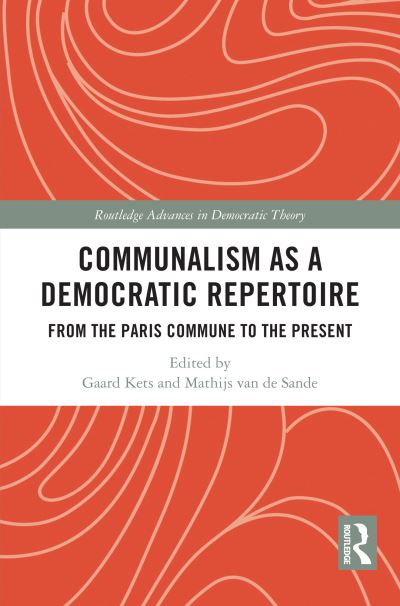
In the 72 days of its existence, the Paris Commune of 1871 was a political and social laboratory where Parisians would experiment with radically democratic urban self-government. Various radical theorists and traditions have claimed the Commune as their own: from the well-known account of Karl Marx and Lenin's State and Revolution to the anarchists Mikhail Bakunin or Peter Kropotkin, and from the council communists in Germany around the end of the Great War to the soixante-huitards in France.
In Communalism as a Democratic Repertoire Gaard Kets and Mathijs van de Sande bring together historians, sociologists, political scientists, theorists, and philosophers to reconstruct how "the Commune" has continued to serve as a source of inspiration to different movements and tendencies throughout the past 150 years, and how communalist thought and practices help us reimagine what radical democracy may look like today.
Divided into three parts, contributors begin by exploring how the Paris Commune shaped political debates and influenced various theoretical oeuvres as well as political practices. Part II develops communalist ideas or strategies in a contemporary context. Part III sheds light on three different contemporary communalist practices in the Middle East, Europe, North America, and Latin America.
Bridging the gap between historical and theoretical accounts of "the Commune," this book will be enlightening for students of democracy and a valuable resource to scholars and activists interested in the problems and possibilities facing democracy today.
| ISBN: | 9781032842783 |
| Publication date: | 16th October 2026 |
| Author: | Gaard Kets, Mathijs van de Sande |
| Publisher: | Routledge an imprint of Taylor & Francis |
| Format: | Paperback |
| Pagination: | 226 pages |
| Series: | Routledge Advances in Democratic Theory |
| Genres: |
Political ideologies and movements Revolutions, uprisings, rebellions Social and political philosophy |
In the 72 days of its existence, the Paris Commune of 1871 was a political and social laboratory where Parisians would experiment with radically democratic urban self-government. Various radical theorists and traditions have claimed the Commune as their own: from the well-known account of Karl Marx and Lenin's State and Revolution to the anarchists Mikhail Bakunin or Peter Kropotkin, and from the council communists in Germany around the end of the Great War to the soixante-huitards in France.In Communalism as a Democratic Repertoire Gaard Kets and Mathijs van de Sande bring together historians, sociologists, political scientists, theorists, and philosophers to reconstruct how "the Commune" has continued to serve as a source of inspiration to different movements and tendencies throughout the past 150 years, and how communalist thought and practices help us reimagine what radical democracy may look like today.
Communalism as a Democratic Repertoire features in the following genres: Political ideologies and movements, Revolutions, uprisings, rebellions, Social and political philosophy
Paperback, Hardback. £43.19, down from the £47.99 cover price. Not Available.
Communalism as a Democratic Repertoire was written by Gaard Kets, Mathijs van de Sande and published by Routledge an imprint of Taylor & Francis
Communalism as a Democratic Repertoire has 226 pages
Yes it is part of Routledge Advances in Democratic Theory series
£43.19, reduced from £47.99. Not Available.