

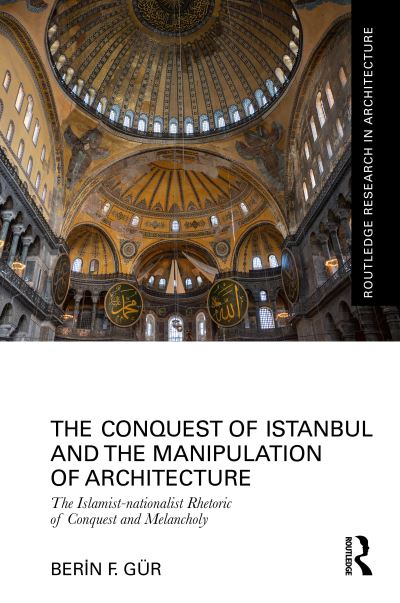
This book explores the contemporary memory of the Ottoman conquest of Constantinople (now Istanbul) in 1453. It focuses on how the conquest is remembered by Islamist-nationalist imagination in Turkey today and how architecture plays a role in shaping this memory, underscoring its susceptibility to political manipulation.
Discussing Islamist-nationalist rhetoric of Istanbul's conquest through the conceptual framework of melancholy-a significant theme in the history of ideas-the argument posits that this narrative is a politically driven endeavor fueled by paranoia, producing melancholy over the conquest of Istanbul. This book redefines melancholy as 'a politically manipulated project', which anchors the imagery of conquest to spatial and architectural symbols of mourning while creating imaginary lost objects. Architecture becomes the book's subject as the bearer of clues to searching for lost objects and as a spatial-political tool of conquest rhetoric, such as the Hagia Sophia in Istanbul and the Panorama 1453 History Museum. As various groups with differing ideologies and identities continue to feel the impact of the conquest, this book also examines the 'other' side of the event-specifically, how the Greeks commemorate the fall of Constantinople, recognizing it as a dark memory from their perspective.
This book targets diverse audiences in cultural studies, social sciences, arts, and humanities-including architecture, history, anthropology, and political studies-interested in Southeast Europe and Islamic societies.
| ISBN: | 9781032751092 |
| Publication date: | 15th August 2025 |
| Author: | Berin F Gür |
| Publisher: | Routledge an imprint of Taylor & Francis |
| Format: | Hardback |
| Pagination: | 212 pages |
| Series: | Routledge Research in Architecture |
| Genres: |
History of architecture Religion and politics City and town planning: architectural aspects Urban communities Nationalism Social and political philosophy Regional / International studies Theory of architecture Islam Regional and area planning Civil engineering, surveying and building The arts: general topics Language teaching and learning |
This book explores the contemporary memory of the Ottoman conquest of Constantinople (now Istanbul) in 1453. It focuses on how the conquest is remembered by Islamist-nationalist imagination in Turkey today and how architecture plays a role in shaping this memory, underscoring its susceptibility to political manipulation.
Discussing Islamist-nationalist rhetoric of Istanbul's conquest through the conceptual framework of melancholy-a significant theme in the history of ideas-the argument posits that this narrative is a politically driven endeavor fueled by paranoia, producing melancholy over the conquest of Istanbul. This book redefines melancholy as 'a politically manipulated project', which anchors the imagery of conquest to spatial and architectural symbols of mourning while creating imaginary lost objects. Architecture becomes the book's subject as the bearer of clues to searching for lost objects and as a spatial-political tool of conquest rhetoric, such as the Hagia Sophia in Istanbul and the Panorama 1453 History Museum. As various groups with differing ideologies and identities continue to feel the impact of the conquest, this book also examines the 'other' side of the event-specifically, how the Greeks commemorate the fall of Constantinople, recognizing it as a dark memory from their perspective.
This book targets diverse audiences in cultural studies, social sciences, arts, and humanities-including architecture, history, anthropology, and political studies-interested in Southeast Europe and Islamic societies.
The Conquest of Istanbul and the Manipulation of Architecture features in the following genres: History of architecture, Religion and politics, City and town planning: architectural aspects, Urban communities, Nationalism, Social and political philosophy, Regional / International studies, Theory of architecture, Islam, Regional and area planning, Civil engineering, surveying and building, The arts: general topics, Language teaching and learning
The Conquest of Istanbul and the Manipulation of Architecture is available in Hardback
The Conquest of Istanbul and the Manipulation of Architecture was written by Berin F Gür and published by Routledge an imprint of Taylor & Francis
The Conquest of Istanbul and the Manipulation of Architecture has 212 pages
Yes it is part of Routledge Research in Architecture series
£139.50