

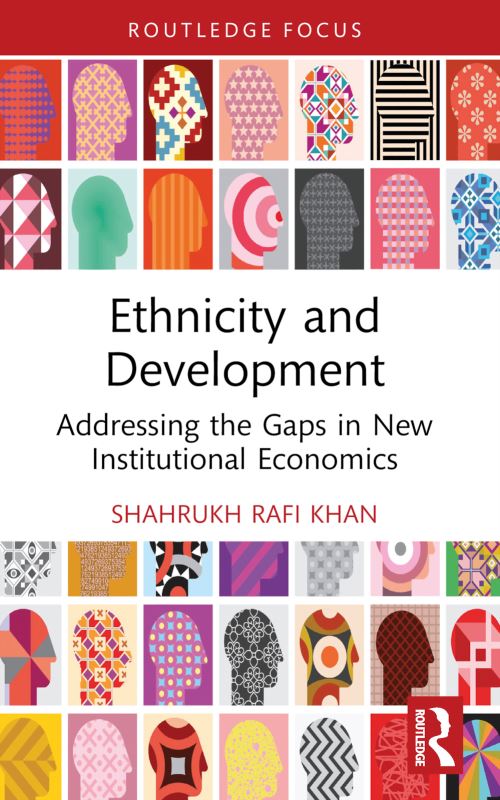
Ethnicity and Development explores the impact of ethnic fragmentation on the success or failure of nations and uses case studies of Bangladesh and Pakistan to illustrate this. It analyzes the role of institutions in engendering economic and social progress and challenges the New Institutional Economics (NIE) narrative.
The book argues that the NIE narrative has some gaps, particularly that it is blind to ethnic fragmentation and therefore does not account for the construction of institutions that can build national cohesion in low- and low-middleincome countries (L/LMICs). It shows that L/LMICs have a different cultural context and that they need to first build national cohesion on a foundation of horizontal - across ethnic groups - and vertical - across classes - equity. The author's analysis also examines other novel issues, such as the boost that is provided by nations acquiring the right of self-determination. Other novelties are the distinction between prime causes (triggers) for economic development and approaches for economic development. More important for this book is the distinction between natural and constructed nations and the conceptual framework presented to analyze their performance. Finally, the study examines the creation of national cohesion in ethnically diverse nations.
Addressing a gap in the literature, this book will be of interest to researchers in development economics, political science and sociology and specialists in comparative politics/political theory with a focus on Area Studies.
| ISBN: | 9781032630830 |
| Publication date: | 14th April 2025 |
| Author: | Shahrukh Rafi Khan |
| Publisher: | Routledge an imprint of Taylor & Francis |
| Format: | Paperback |
| Pagination: | 78 pages |
| Series: | Routledge Studies in the Growth Economies of Asia |
| Genres: |
Development economics and emerging economies Ethnic studies Social and cultural anthropology International economics Sociology Regional / International studies Political economy |
Ethnicity and Development explores the impact of ethnic fragmentation on the success or failure of nations and uses case studies of Bangladesh and Pakistan to illustrate this. It analyzes the role of institutions in engendering economic and social progress and challenges the New Institutional Economics (NIE) narrative.
The book argues that the NIE narrative has some gaps, particularly that it is blind to ethnic fragmentation and therefore does not account for the construction of institutions that can build national cohesion in low- and low-middleincome countries (L/LMICs). It shows that L/LMICs have a different cultural context and that they need to first build national cohesion on a foundation of horizontal - across ethnic groups - and vertical - across classes - equity. The author's analysis also examines other novel issues, such as the boost that is provided by nations acquiring the right of self-determination. Other novelties are the distinction between prime causes (triggers) for economic development and approaches for economic development. More important for this book is the distinction between natural and constructed nations and the conceptual framework presented to analyze their performance. Finally, the study examines the creation of national cohesion in ethnically diverse nations.
Addressing a gap in the literature, this book will be of interest to researchers in development economics, political science and sociology and specialists in comparative politics/political theory with a focus on Area Studies.
Ethnicity and Development features in the following genres: Development economics and emerging economies, Ethnic studies, Social and cultural anthropology, International economics, Sociology, Regional / International studies, Political economy
Ethnicity and Development is available in Paperback, Hardback
Ethnicity and Development was written by Shahrukh Rafi Khan and published by Routledge an imprint of Taylor & Francis
Ethnicity and Development has 78 pages
Yes it is part of Routledge Studies in the Growth Economies of Asia series
£22.49