

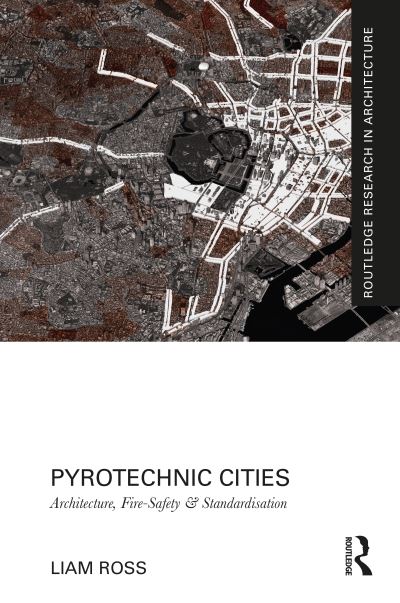
This book explores the relationship between architecture, government and fire. It posits that, through the question of fire-safety standardisation, building design comes to be both a problem for, and a tool of, government. Through a close study of fire-safety standards it demonstrates the shaping effect that architecture and the city have on the way we think about governing.
Opening with an investigation into the Grenfell Tower fire and the political actors who sought to enrol it in programmes of governmental reform before contextualising the research in current literature, the book takes four city studies, each beginning with a specific historic fire: The 1654 Great Fire of Meirecki, Edo; the 1877 town fire of Lagos; the 1911 Empire Palace Theatre fire, Edinburgh; and the 2001 World Trade Centre attack, New York. Each study identifies the governmental response to the fire, safety standards and codes designed in its wake and how these new processes spread and change.
Drawing on the work of sociologists John Law and Anne Marie Mol and their concept of 'Fire Space', it describes the way that architectural design, through the medium of fire, is an instrument of political agency. Pyrotechnic Cities is a critical investigation into these political implications, written for academics, researchers and students in architectural history and theory, infrastructure studies and governance.
| ISBN: | 9781032214740 |
| Publication date: | 29th January 2024 |
| Author: | Liam Ross |
| Publisher: | Routledge an imprint of Taylor & Francis |
| Format: | Paperback |
| Pagination: | 228 pages |
| Series: | Routledge Research in Architecture |
| Genres: |
Architectural structure and design Risk assessment Urban communities Health and safety in the workplace Fire protection and safety Theory of architecture History of architecture Interdisciplinary studies |
This book explores the relationship between architecture, government and fire. It posits that, through the question of fire-safety standardisation, building design comes to be both a problem for, and a tool of, government.
Pyrotechnic Cities features in the following genres: Architectural structure and design, Risk assessment, Urban communities, Health and safety in the workplace, Fire protection and safety, Theory of architecture, History of architecture, Interdisciplinary studies
Paperback, Hardback, Ebook. £42.29, down from the £46.99 cover price. Not Available.
Pyrotechnic Cities was written by Liam Ross and published by Routledge an imprint of Taylor & Francis
Pyrotechnic Cities has 228 pages
Yes it is part of Routledge Research in Architecture series
£42.29, reduced from £46.99. Not Available.