

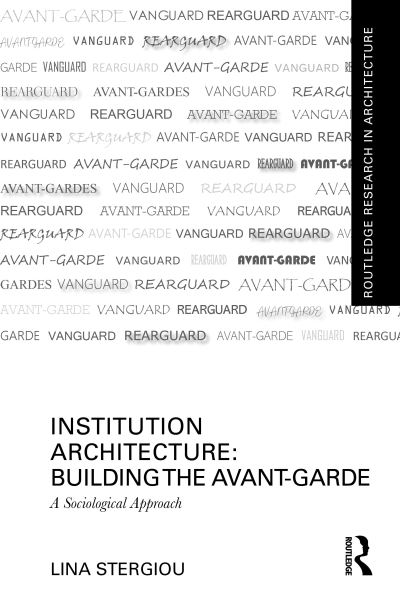
Institution Architecture: Building the Avant-Garde takes a terminological, sociological, and semiological approach that develops by tracing the 'avant-garde' in a century span of literatures for a textual analysis, unpacking the text, and in a process analysis, interpreting it.
The sources consist of 825 well-known, globally influential European, including Russian, architectural literatures of the extended 1920s, and of Anglo-Saxon literatures of the extended 1960s to the 2010s. The book traces the connotations that the term 'avant-garde' acquired in them and shows the different notions under the 'avant-garde' signifier, directing attention to the term's early twentieth-century roots and modes; its 1960s rising usage, modes, and function; and its post-1960s to 2010s developments. It sheds light on the sociological topography of the avant-garde, and through the writings, on the ways in which the term and avant-gardism connected, the actors, agencies, and mediators therein, on the terms' techniques and modes, indicating the reasons for its heretofore limited systematic inquiry. The book aims at unravelling a century-old 'avant-garde' mystic function for unlocking horizontal, plural, and transparent conversations about interdisciplinary futures of architecture, cross-disciplinary dialogues, and liberatory dynamics. The book will therefore be relevant to scholars and researchers interested in the avant-garde in architecture, and the avant-garde as a transdisciplinary subject.
| ISBN: | 9781032191270 |
| Publication date: | 19th December 2025 |
| Author: | Lina Stergiou |
| Publisher: | Routledge an imprint of Taylor & Francis |
| Format: | Hardback |
| Pagination: | 330 pages |
| Series: | Routledge Research in Architecture |
| Genres: |
History of architecture Cultural studies Regional / International studies History of art The arts: general topics Civil engineering, surveying and building History and Archaeology |
Institution Architecture: Building the Avant-Garde takes a terminological, sociological, and semiological approach that develops by tracing the 'avant-garde' in a century span of literatures for a textual analysis, unpacking the text, and in a process analysis, interpreting it.
The sources consist of 825 well-known, globally influential European, including Russian, architectural literatures of the extended 1920s, and of Anglo-Saxon literatures of the extended 1960s to the 2010s. The book traces the connotations that the term 'avant-garde' acquired in them and shows the different notions under the 'avant-garde' signifier, directing attention to the term's early twentieth-century roots and modes; its 1960s rising usage, modes, and function; and its post-1960s to 2010s developments. It sheds light on the sociological topography of the avant-garde, and through the writings, on the ways in which the term and avant-gardism connected, the actors, agencies, and mediators therein, on the terms' techniques and modes, indicating the reasons for its heretofore limited systematic inquiry. The book aims at unravelling a century-old 'avant-garde' mystic function for unlocking horizontal, plural, and transparent conversations about interdisciplinary futures of architecture, cross-disciplinary dialogues, and liberatory dynamics. The book will therefore be relevant to scholars and researchers interested in the avant-garde in architecture, and the avant-garde as a transdisciplinary subject.
Institution Architecture features in the following genres: History of architecture, Cultural studies, Regional / International studies, History of art, The arts: general topics, Civil engineering, surveying and building, History and Archaeology
Institution Architecture is available in Hardback
Institution Architecture was written by Lina Stergiou and published by Routledge an imprint of Taylor & Francis
Institution Architecture has 330 pages
Yes it is part of Routledge Research in Architecture series
£139.50