

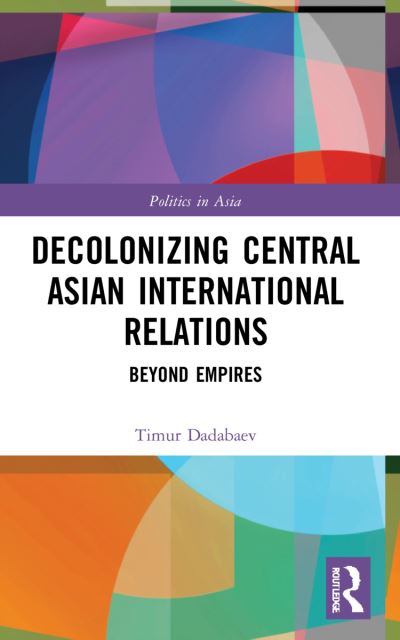
This book unpacks the main narratives used in international relations to depict and explain existing inter-state relations in Central Asia, with a focus on the construction of fairer international relations along the Silk Road.
The book points to the need to decolonize international relations in the Central Asian region to present a fair representation of the regional states in international affairs. In doing so, the book exposes the concepts and stereotypes that have been imposed on the Central Asian region by dominant assumptions in contemporary international relations.
Offering empirical grounding for alternative views, the author suggests that Western international relations make the same mistakes in the Central Asian region that the Russian Marxists made when they attributed a narrative of modernity along the lines of the progress made in Germany and Russia. In such a structure, both Russian Marxist attempts and liberalist Western ideas disregard the fact that the region has its own model of modernity and progress, which does not necessarily involve an appeal to the modern nation state, ethnicity and state building.
The book sheds lights on the prospects of coordinated development of Central Asia and Afghanistan. It also provides insights into the development of post-Socialist Asia in its relations with Russia, China, Japan and South Korea.
Contributing to the task of placing Central Asia in discussions in the discipline of international relations, this book will be of interest to academics working in the fields of international relations and Asian politics, in particular Central Asian studies.
| ISBN: | 9781032009384 |
| Publication date: | 31st May 2023 |
| Author: | Timur Dadabaev |
| Publisher: | Routledge an imprint of Taylor & Francis |
| Format: | Paperback |
| Pagination: | 160 pages |
| Series: | Politics in Asia |
| Genres: |
Geopolitics Diplomacy Decolonisation of knowledge / Decoloniality |
This book unpacks the main narratives used in international relations to depict and explain existing inter-state relations in Central Asia, with a focus on the construction of fairer international relations along the Silk Road.The book points to the need to decolonize international relations in the Central Asian region to present a fair representation of the regional states in international affairs. In doing so, the book exposes the concepts and stereotypes that have been imposed on the Central Asian region by dominant assumptions in contemporary international relations.
Decolonizing Central Asian International Relations features in the following genres: Geopolitics, Diplomacy, Decolonisation of knowledge / Decoloniality
Paperback, Hardback, Ebook. £42.29, down from the £46.99 cover price. Not Available.
Decolonizing Central Asian International Relations was written by Timur Dadabaev and published by Routledge an imprint of Taylor & Francis
Decolonizing Central Asian International Relations has 160 pages
Yes it is part of Politics in Asia series
£42.29, reduced from £46.99. Not Available.