

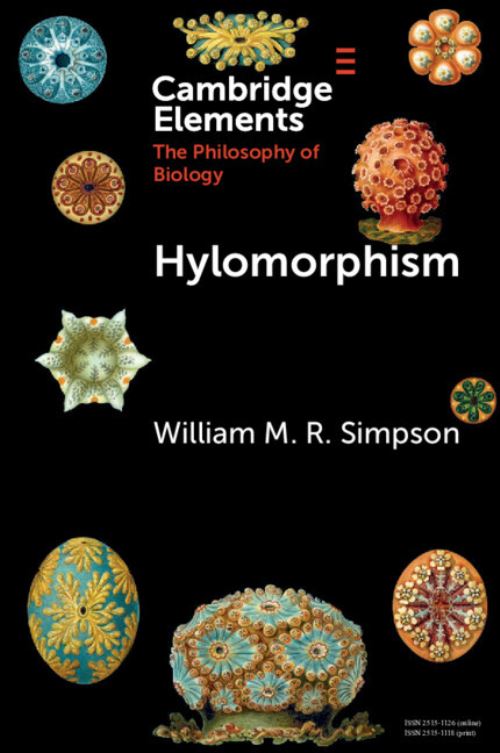
This Element introduces Aristotle's doctrine of hylomorphism, which provides an account of substances in terms of their 'matter' and 'form', adapting and applying it to the interface between physics and biology. It begins by indicating some reasons for the current revival of hylomorphism and by suggesting a way of classifying the confusing array of hylomorphisms that have arisen. It argues that, in order for composite entities to have irreducible causal powers which make a difference to how nature unfolds, they must have substantial forms which transform their matter such that the powers of their physical parts are grounded in the composite entity as a whole. It suggests how a contemporary form of hylomorphism might contribute to the philosophy of biology by grounding the non-intentional form of teleology that features in the identity conditions of biological systems, affirming a real distinction between living organisms and heaps of matter. This title is also available as Open Access on Cambridge Core.
| ISBN: | 9781009012843 |
| Publication date: | 20th July 2023 |
| Author: | William M R Simpson |
| Publisher: | Cambridge University Press |
| Format: | Paperback |
| Pagination: | 75 pages |
| Series: | Elements in the Philosophy of Biology |
| Genres: |
Philosophy of science Ancient Greek and Roman philosophy Philosophy: metaphysics and ontology Biology, life sciences |
This Element introduces Aristotle's doctrine of hylomorphism, which provides an account of substances in terms of their 'matter' and 'form', adapting and applying it to the interface between physics and biology. It begins by indicating some reasons for the current revival of hylomorphism and by suggesting a way of classifying the confusing array of hylomorphisms that have arisen. It argues that, in order for composite entities to have irreducible causal powers which make a difference to how nature unfolds, they must have substantial forms which transform their matter such that the powers of their physical parts are grounded in the composite entity as a whole. It suggests how a contemporary form of hylomorphism might contribute to the philosophy of biology by grounding the non-intentional form of teleology that features in the identity conditions of biological systems, affirming a real distinction between living organisms and heaps of matter. This title is also available as Open Access on Cambridge Core.
Hylomorphism features in the following genres: Philosophy of science, Ancient Greek and Roman philosophy, Philosophy: metaphysics and ontology, Biology, life sciences
Hylomorphism is available in Paperback, Hardback
Hylomorphism was written by William M R Simpson and published by Cambridge University Press
Hylomorphism has 75 pages
Yes it is part of Elements in the Philosophy of Biology series
£16.20