

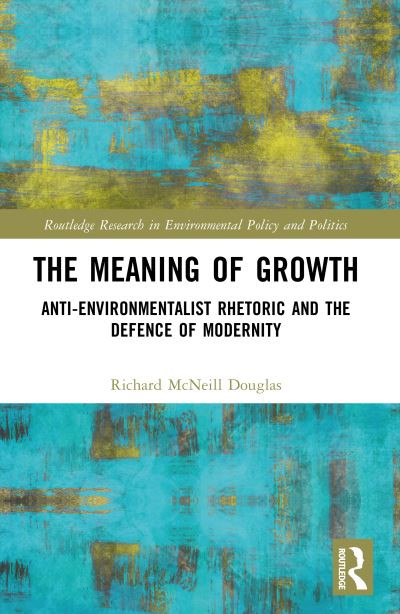
Since the Limits to Growth report was published in 1972 it has been widely known that a commitment to endless growth was putting us on course for environmental disaster-so why have we failed to take decisive political action in the half-century since then? In The Meaning of Growth, Richard McNeill Douglas uses interpretive social science to uncover the cultural roots of political resistance to environmental science and policy.
Through a close reading of anti-environmentalist rhetoric the book identifies its idolisation of growth as a defence of a modern (Western-European) world-view, focusing on values of freedom, power, and immortality. The significance of these findings is drawn out by applying the 'secularisation thesis', a theoretical account of the development of a modern understanding of reality from a theological world-view to which it is ostensibly opposed.
This framework is used to offer a deep interpretation of what is at stake in environmental debate: that to accept there are limits to growth means abandoning crucial elements of a faith in a theodicy of progress that makes life meaningful in a secular age. Douglas concludes by suggesting that the precondition for political action on the environment is a change of philosophical perspective that provides for a sense of meaning in a world of limits.
This book should be of interest to academics in the fields of environmental sociology and communications studies, as well as activists interested in understanding the motivations of anti-environmentalist campaigners and how to counter their influence.
| ISBN: | 9781003864189 |
| Publication date: | 28th December 2026 |
| Author: | Richard McNeill Douglas |
| Publisher: | Routledge an imprint of Taylor & Francis |
| Format: | Paperback |
| Pagination: | 188 pages |
| Series: | Routledge Research in Environmental Policy and Politics |
| Genres: |
Environmental policy and protocols Media studies Sociology |
Since the Limits to Growth report was published in 1972 it has been widely known that a commitment to endless growth was putting us on course for environmental disaster-so why have we failed to take decisive political action in the half-century since then? In The Meaning of Growth, Richard McNeill Douglas uses interpretive social science to uncover the cultural roots of political resistance to environmental science and policy.Through a close reading of anti-environmentalist rhetoric the book identifies its idolisation of growth as a defence of a modern (Western-European) world-view, focusing on values of freedom, power, and immortality.
The Meaning of Growth features in the following genres: Environmental policy and protocols, Media studies, Sociology
Paperback, Hardback. £43.19, down from the £47.99 cover price. Not Available.
The Meaning of Growth was written by Richard McNeill Douglas and published by Routledge an imprint of Taylor & Francis
The Meaning of Growth has 188 pages
Yes it is part of Routledge Research in Environmental Policy and Politics series
£43.19, reduced from £47.99. Not Available.