

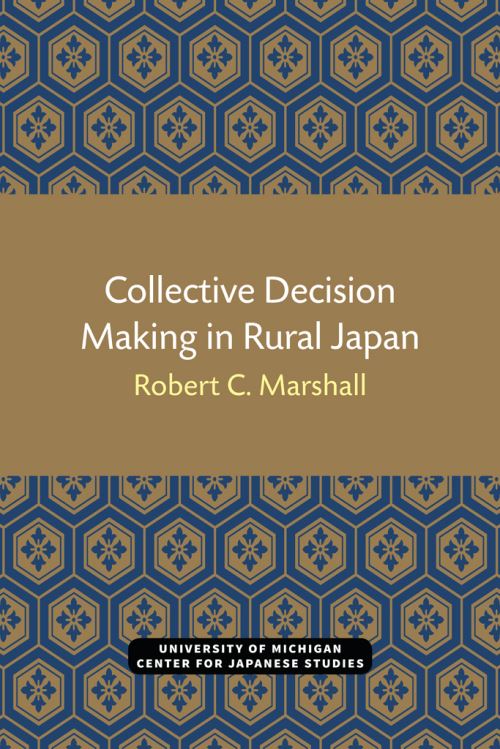
This study is a result of three continuous years of fieldwork in a hamlet in rural Japan. The data presented and analyzed here consist of records from participant observation, formal and informal interviews, casual conversation and formal questionnaires, and public and private documents. The subject of this research is group decision making, and the results of this process are, after all, a matter of public record. The major conclusions of this study are outlined in their simplest and most straightforward form. A hamlet is fundamentally a nexus for the organization of productive exchange among member households, the form of exchange through which two or more parties actively combine their resources to produce something of value not available, or as cheaply available, to any of them separately. Defection from productive exchange agreements by hamlet members is reduced by making access to future valuable transactions and corporate property contingent upon the integrity of each current exchange transaction. This method of combining a common interest in production with contingent access to productive resources is termed mutual investment and is the major source of consensus in hamlet decision making. When only cooperate resources are at issue, decisions regularly result in unanimity. When a course of action can be implemented only if hamlet members relinquish control over individually held resources, a division will emerge among the membership. Whether or not a formal vote is taken, the distribution of differing opinion will be known through more informal means of communication. In all cases of division, by the time the course of action to be implemented is formally announced, the minority in opposition will be extremely small. The question then must be resolved whether those in the minority will participate in the implementation or resign as hamlet members. This book is written with two rather disparate audiences in mind: readers interested primarily in exchange and decision-making phenomenon, on the one hand, and readers interested primarily in the unity of experience represented by the Japanese sensibility, on the other.
| ISBN: | 9780939512171 |
| Publication date: | 1st January 1984 |
| Author: | Robert C Marshall |
| Publisher: | University of Michigan, Center for Japanese Studies an imprint of University of Michigan Press |
| Format: | Paperback |
| Pagination: | 178 pages |
| Series: | Michigan Papers in Japanese Studies |
| Genres: |
Ethnic studies Sociology History |
This study is a result of three continuous years of fieldwork in a hamlet in rural Japan. The data presented and analyzed here consist of records from participant observation, formal and informal interviews, casual conversation and formal questionnaires, and public and private documents.
Collective Decision Making in Rural Japan features in the following genres: Ethnic studies, Sociology, History
Paperback. Not Available.
Collective Decision Making in Rural Japan was written by Robert C Marshall and published by University of Michigan, Center for Japanese Studies an imprint of University of Michigan Press
Collective Decision Making in Rural Japan has 178 pages
Yes it is part of Michigan Papers in Japanese Studies series