

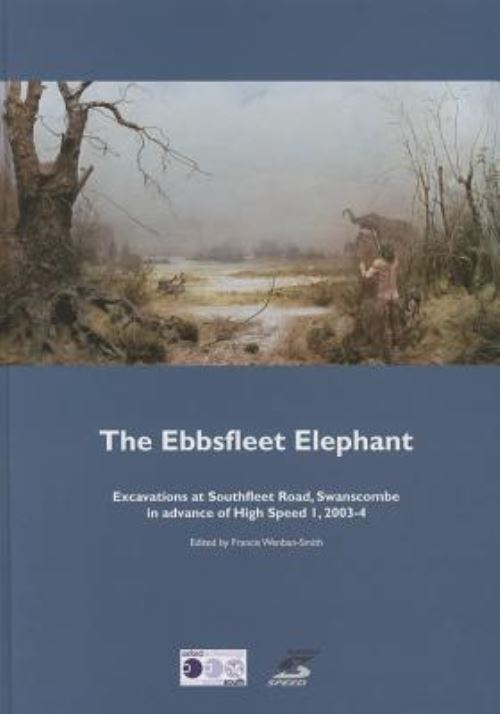
This is the final volume in the monograph series resulting from archaeological excavations in the Ebbsfleet Valley in advance of High Speed 1 and the Ebbsfleet International station. It provides the full account of the discovery, excavation and subsequent analysis of rich and deeply buried archaeological horizons found late in the construction programme, dating to early in the Palaeolithic and associated with the Hoxnian interglacial between about 425,000 and 375,000 years ago.The highlight of this work was recovery of the remains of an extinct straight-tusked elephant Palaeoloxodon antiquus surrounded by the undisturbed scatter of flint tools used for its butchery, made and abandoned at the spot.
Rich fossil palaeo-environmental remains provide a remarkable record of the climate and environment, showing that the elephant lived and died at a time of peak interglacial warmth, when the Ebbsfleet Valley was a lush, densely-wooded tributary of the Thames, containing a quiet, almost stagnant swamp. The abundant lithic remains from the elephant horizon are attributable to the Clactonian industrial tradition, after Clacton-on-Sea, Essex where similar remains have been found.
The evidence from this new site provides the best record yet of Clactonian remains from the Hoxnian, establishing that Britain was re-settled (after local extinction due to the great Anglian glaciation) by hominins who did not make handaxes, generally the typical artefact of the earlier Palaeolithic. The elephant horizon is overlain by a younger deposit rich in handaxes of various forms, including sharply pointed specimens, bluntly pointed sub-cordates and twisted ovates.
Possible interpretations for this sequence of greatly contrasting lithic industries are discussed in the volume.Finally, this monograph provides a fascinating case-study of Palaeolithic excavation methods, and how archaeological work is carried out in conjunction with large engineering developments such as High Speed 1.
| ISBN: | 9780904220735 |
| Publication date: | 31st August 2013 |
| Author: | Peter Allen |
| Illustrator: | Leo Heatley |
| Publisher: | Oxford Archaeology |
| Format: | Hardback |
| Pagination: | 595 pages |
| Series: | Oxford Archaeology Monograph |
| Genres: |
Archaeology Archaeological theory Archaeology by period / region |
This is the final volume in the monograph series resulting from archaeological excavations in the Ebbsfleet Valley in advance of High Speed 1 and the Ebbsfleet International station. It provides the full account of the discovery, excavation and subsequent analysis of rich and deeply buried archaeological horizons found late in the construction programme, dating to early in the Palaeolithic and associated with the Hoxnian interglacial between about 425,000 and 375,000 years ago.The highlight of this work was recovery of the remains of an extinct straight-tusked elephant Palaeoloxodon antiquus surrounded by the undisturbed scatter of flint tools used for its butchery, made and abandoned at the spot.
The Ebbsfleet Elephant features in the following genres: Archaeology, Archaeological theory, Archaeology by period / region
Hardback. £22.50, down from the £25.00 cover price. Not Available.
The Ebbsfleet Elephant was written by Peter Allen and published by Oxford Archaeology
The Ebbsfleet Elephant has 595 pages
Yes it is part of Oxford Archaeology Monograph series
£22.50, reduced from £25.00. Not Available.