

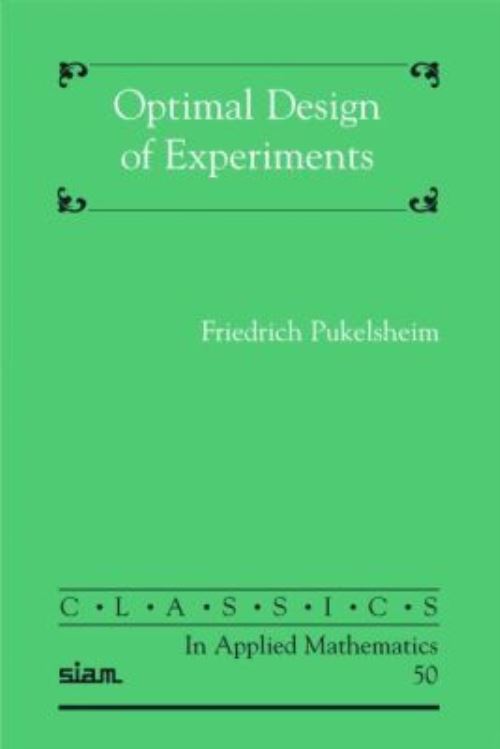
Optimal Design of Experiments offers a rare blend of linear algebra, convex analysis, and statistics. The optimal design for statistical experiments is first formulated as a concave matrix optimization problem. Using tools from convex analysis, the problem is solved generally for a wide class of optimality criteria such as D-, A-, or E-optimality.
The book then offers a complementary approach that calls for the study of the symmetry properties of the design problem, exploiting such notions as matrix majorization and the Kiefer matrix ordering. The results are illustrated with optimal designs for polynomial fit models, Bayes designs, balanced incomplete block designs, exchangeable designs on the cube, rotatable designs on the sphere, and many other examples.
Since the book's initial publication in 1993, readers have used its methods to derive optimal designs on the circle, optimal mixture designs, and optimal designs in other statistical models. Using local linearization techniques, the methods described in the book prove useful even for nonlinear cases, in identifying practical designs of experiments.
| ISBN: | 9780898716047 |
| Publication date: | 30th July 2006 |
| Author: | Friedrich Pukelsheim |
| Publisher: | Society for Industrial and Applied Mathematics an imprint of SIAM - Society for Industrial and Applied Mathematics |
| Format: | Paperback |
| Pagination: | 454 pages |
| Series: | Classics in Applied Mathematics |
| Genres: |
Applied mathematics Probability and statistics |
Optimal Design of Experiments offers a rare blend of linear algebra, convex analysis, and statistics. The optimal design for statistical experiments is first formulated as a concave matrix optimization problem.
Optimal Design of Experiments features in the following genres: Applied mathematics, Probability and statistics
Paperback. Not Available.
Optimal Design of Experiments was written by Friedrich Pukelsheim and published by Society for Industrial and Applied Mathematics an imprint of SIAM - Society for Industrial and Applied Mathematics
Optimal Design of Experiments has 454 pages
Yes it is part of Classics in Applied Mathematics series