

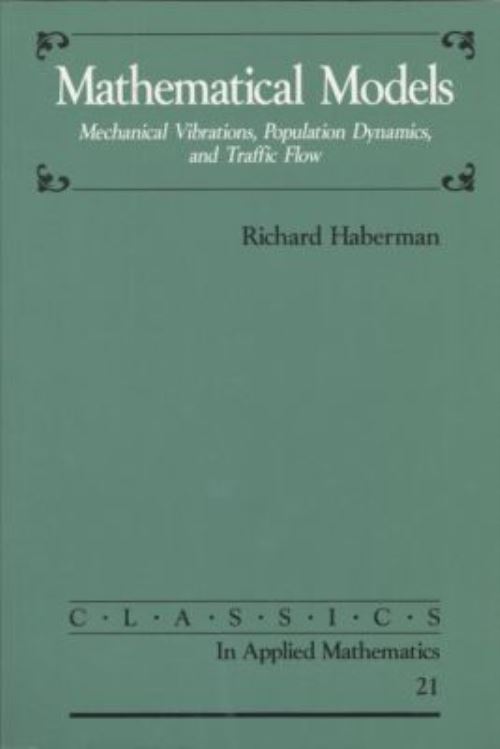
Mathematics is a grand subject in the way it can be applied to various problems in science and engineering. To use mathematics, one needs to understand the physical context. The author uses mathematical techniques along with observations and experiments to give an in-depth look at models for mechanical vibrations, population dynamics, and traffic flow. Equal emphasis is placed on the mathematical formulation of the problem and the interpretation of the results.
In the sections on mechanical vibrations and population dynamics, the author emphasizes the nonlinear aspects of ordinary differential equations and develops the concepts of equilibrium solutions and their stability. He introduces phase plane methods for the nonlinear pendulum and for predator-prey and competing species models.
Haberman develops the method of characteristics to analyze the nonlinear partial differential equations that describe traffic flow. Fan-shaped characteristics describe the traffic situation that occurs when a traffic light turns green and shock waves describe the effects of a red light or traffic accident.
Although it was written over 20 years ago, this book is still relevant. It is intended as an introduction to applied mathematics, but can be used for undergraduate courses in mathematical modeling or nonlinear dynamical systems or to supplement courses in ordinary or partial differential equations.
| ISBN: | 9780898714081 |
| Publication date: | 31st March 1998 |
| Author: | Richard Haberman |
| Publisher: | Society for Industrial and Applied Mathematics an imprint of SIAM - Society for Industrial and Applied Mathematics |
| Format: | Paperback |
| Pagination: | 402 pages |
| Series: | Classics in Applied Mathematics |
| Genres: |
Applied mathematics Mathematical physics |
Mathematics is a grand subject in the way it can be applied to various problems in science and engineering. To use mathematics, one needs to understand the physical context.
Mathematical Models features in the following genres: Applied mathematics, Mathematical physics
Paperback. Not Available.
Mathematical Models was written by Richard Haberman and published by Society for Industrial and Applied Mathematics an imprint of SIAM - Society for Industrial and Applied Mathematics
Mathematical Models has 402 pages
Yes it is part of Classics in Applied Mathematics series