

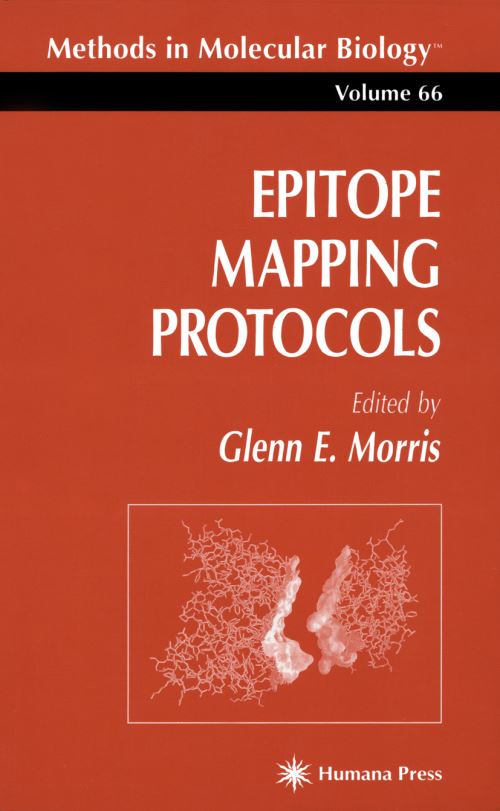
Interest in epitope mapping, or finding out where antibodies bind to their antigens, is by no means restricted to immunologists, but is shared by biolo- gists from a wide range of disciplines in which antibodies are used as molecu- lar reagents. The epitope mapper may be interested in studying protein-protein interactions, in developing an immunoassay, in producing protective peptide vaccines, in investigating the pathogenesis of autoimmune diseases, or in defining protein topology in intact cells or organelles, to mention only a few of the possibilities.
The aim of Epitope Mapping Protocols is to provide both a useful range of alternative practical methods for the experienced mapper and a fairly com- prehensive introduction for someone embarking on antibody production and mapping for the first time. Contributors were encouraged to illustrate their protocols with results from their own research and most of them elected to do so. After an introductory chapter, the protocols are arranged in three groups:
| ISBN: | 9780896033757 |
| Publication date: | 1st August 1996 |
| Author: | Glenn E Morris |
| Publisher: | Humana Press |
| Format: | Paperback |
| Pagination: | 416 pages |
| Series: | Methods in Molecular Biology |
| Genres: |
Biochemistry |
Interest in epitope mapping, or finding out where antibodies bind to their antigens, is by no means restricted to immunologists, but is shared by biolo- gists from a wide range of disciplines in which antibodies are used as molecu- lar reagents. The epitope mapper may be interested in studying protein-protein interactions, in developing an immunoassay, in producing protective peptide vaccines, in investigating the pathogenesis of autoimmune diseases, or in defining protein topology in intact cells or organelles, to mention only a few of the possibilities.
Epitope Mapping Protocols features in the following genres: Biochemistry
Paperback. Not Available.
Epitope Mapping Protocols was written by Glenn E Morris and published by Humana Press
Epitope Mapping Protocols has 416 pages
Yes it is part of Methods in Molecular Biology series