

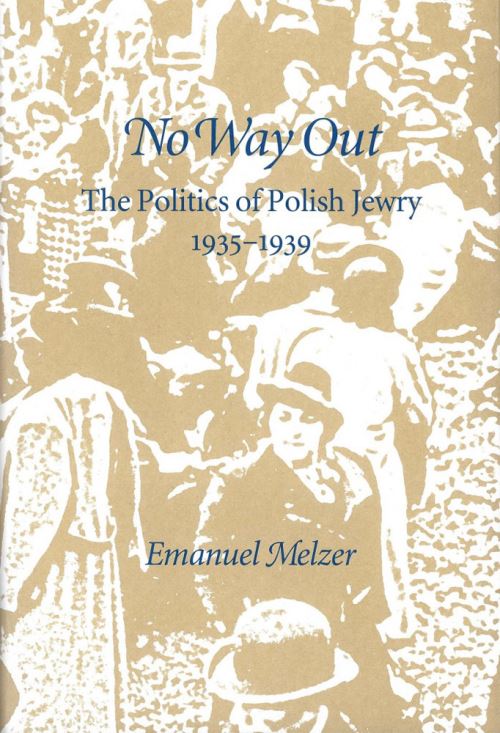
This scholarly study sheds important new light on the politics of Polish Jewry on the eve of its destruction. Drawing from sources in the Polish Jewish and non-Jewish press and from archives in Europe, Israel, and the United States, Emanuel Melzer examines the efforts of Jews in this major center of Jewish life to secure its existence and advance its interests in the late 1930s, when the radicalization of antisemitism became an increasingly prominent theme in the countrys political life.
With the death of Pilsudski, the prognosis for the Polish Jews appeared increasingly bleak, as hostile forces sought to abrogate their constitutional rights and force them to leave the country en masse. The enmity they experienced drew in no small measure from the example of Nazi Germany, which did not hesitate to portray the Jews as the common enemy of Germans and Poles alike. In the face of these developments, Polish Jews attempted to wage a coordinated and concerted political battle against the economic persecution, hostile administrative practices, discriminatory legislation, and violent riots that increasingly pervaded their daily lives.
Melzer recounts those attempts and analyzes their failure. Of the three primary groups among Polish Jewrythe Zionists, Agudas Yisroel, and the Bundonly the last was capable of carrying on effective opposition to anti-Jewish forces. But it was not prepared to join with nonproletarian Jewish groups in an all-Jewish defense.
The Jewish press, too, was not able to forge a unified Jewish organizational framework, tied as it was to the existing political parties and reflecting their attitudes and shortcomings. The only official political voice of Polish Jewry was the small Jewish parliamentary caucus. Although respected by much of the Jewish public, the Sejm and Senat deputies were not recognized as its legitimate spokesmen and usually acted without coordinating their interventions with one another.
As a result, the most effective Jewish actions were undertaken on the local levelnotably the self-defense organized during the Przytyk pogrom and the stubborn battle of Jewish students against the ghetto benches. Melzer demonstrates that the vociferous Jewish public debate over questions of policy and the tenacious daily struggles against discrimination had little effect upon Polish Jewrys deteriorating situation. Without charismatic leadership and an organizational framework based on common Jewish destiny and mutual identification, its ability to confront the grave challenges that lay ahead was seriously impaired.
With the approach of war, many felt they were trapped with no way out, left to face the Nazi onslaught virtually alone.
| ISBN: | 9780822963912 |
| Publication date: | 31st December 2016 |
| Author: | Emanuel Melzer |
| Publisher: | Hebrew Union College Press |
| Format: | Paperback |
| Pagination: | 248 pages |
| Series: | Monographs of the Hebrew Union College |
| Genres: |
Social groups: religious groups and communities Politics and government |
This scholarly study sheds important new light on the politics of Polish Jewry on the eve of its destruction. Drawing from sources in the Polish Jewish and non-Jewish press and from archives in Europe, Israel, and the United States, Emanuel Melzer examines the efforts of Jews in this major center of Jewish life to secure its existence and advance its interests in the late 1930s, when the radicalization of antisemitism became an increasingly prominent theme in the countrys political life.
No Way Out features in the following genres: Social groups: religious groups and communities, Politics and government
Paperback, Hardback. Not Available.
No Way Out was written by Emanuel Melzer and published by Hebrew Union College Press
No Way Out has 248 pages
Yes it is part of Monographs of the Hebrew Union College series