

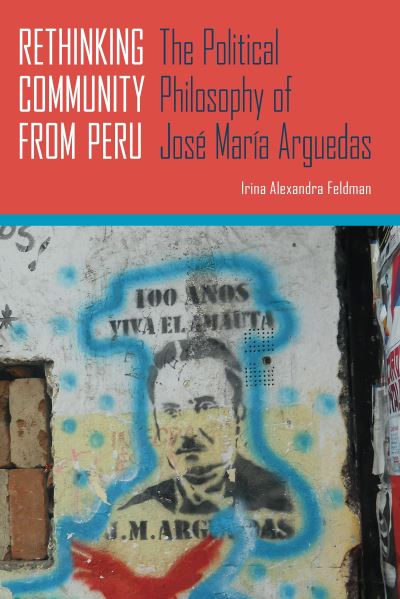
Peruvian novelist, poet, and anthropologist José Marìa Arguedas (1911-1969) was a highly conflicted figure. As a mestizo, both European and Quechua blood ran through his veins and into his cosmology and writing. Arguedas's Marxist influences and ethnographic work placed him in direct contact with the subalterns he would champion in his stories. His exposés of the conflicts between Indians and creoles, and workers and elites were severely criticized by his contemporaries, who sought homogeneity in the nation-building project of Peru.
In Rethinking Community from Peru, Irina Alexandra Feldman examines the deep political connotations and current relevance of Arguedas's fiction to the Andean region. Looking principally to his most ambitious and controversial work, All the Bloods, Feldman analyzes Arguedas's conceptions of community, political subjectivity, sovereignty, juridical norm, popular actions, and revolutionary change. She deconstructs his particular use of language, a mix of Quechua and Spanish, as a vehicle to express the political dualities in the Andes. As Feldman shows, Arguedas's characters become ideological speakers and the narrator's voice is often absent, allowing for multiple viewpoints and a powerful realism. Feldman examines Arguedas's other novels to augment her theorizations, and grounds her analysis in a dialogue with political philosophers Walter Benjamin, Jean-Luc Nancy, Carl Schmitt, Jacques Derrida, Ernesto Laclau, and ¦lvaro Garcìa-Linera, among others.
In the current political climate, Feldman views the promise of Arguedas's vision in light of Evo Morales's election and the Bolivian plurality project recognizing indigenous autonomy. She juxtaposes the Bolivian situation with that of Peru, where comparatively limited progress has been made towards constitutional recognition of the indigenous groups. As Feldman demonstrates, the prophetic relevance of Arguedas's constructs lie in their recognition of the sovereignty of all ethnic groups and their coexistence in the modern democratic nation-state, in a system of heterogeneity through autonomy-not homogeneity through suppression. Tragically for Arguedas, it was a philosophy he could not reconcile with the politics of his day, or from his position within Peruvian society.
| ISBN: | 9780822963073 |
| Publication date: | 27th August 2014 |
| Author: | Irina Alexandra Feldman |
| Publisher: | University of Pittsburgh Press |
| Format: | Paperback |
| Pagination: | 200 pages |
| Series: | Illuminations |
| Genres: |
Literature: history and criticism |
Peruvian novelist, poet, and anthropologist José Marìa Arguedas (1911-1969) was a highly conflicted figure. As a mestizo, both European and Quechua blood ran through his veins and into his cosmology and writing.
Rethinking Community from Peru features in the following genres: Literature: history and criticism
Paperback. £36.86, down from the £40.95 cover price. Not Available.
Rethinking Community from Peru was written by Irina Alexandra Feldman and published by University of Pittsburgh Press
Rethinking Community from Peru has 200 pages
Yes it is part of Illuminations series
£36.86, reduced from £40.95. Not Available.