
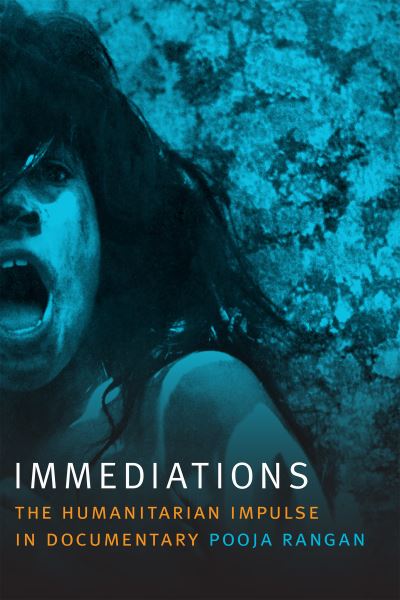
Endangered life is often used to justify humanitarian media intervention, but what if suffering humanity is both the fuel and outcome of such media representations? Pooja Rangan argues that this vicious circle is the result of immediation, a prevailing documentary ethos that seeks to render human suffering urgent and immediate at all costs. Rangan interrogates this ethos in films seeking to "give a voice to the voiceless," an established method of validating the humanity of marginalized subjects, including children, refugees, autistics, and animals. She focuses on multiple examples of documentary subjects being invited to demonstrate their humanity: photography workshops for the children of sex workers in Calcutta; live eyewitness reporting by Hurricane Katrina survivors; attempts to facilitate speech in nonverbal autistics; and painting lessons for elephants. These subjects are obliged to represent themselves using immediations-tropes that reinforce their status as the "other" and reproduce definitions of the human that exclude non-normative modes of thinking, being, and doing. To counter these effects, Rangan calls for an approach to media that aims not to humanize but to realize the full, radical potential of giving the camera to the other.
Buy from our bookstore and 25% of the cover price will be given to a school of your choice to buy more books. *15% of eBooks.
Frequently asked questions
Endangered life is often used to justify humanitarian media intervention, but what if suffering humanity is both the fuel and outcome of such media representations? Pooja Rangan argues that this vicious circle is the result of immediation, a prevailing documentary ethos that seeks to render human suffering urgent and immediate at all costs. Rangan interrogates this ethos in films seeking to "give a voice to the voiceless," an established method of validating the humanity of marginalized subjects, including children, refugees, autistics, and animals. She focuses on multiple examples of documentary subjects being invited to demonstrate their humanity: photography workshops for the children of sex workers in Calcutta; live eyewitness reporting by Hurricane Katrina survivors; attempts to facilitate speech in nonverbal autistics; and painting lessons for elephants. These subjects are obliged to represent themselves using immediations-tropes that reinforce their status as the "other" and reproduce definitions of the human that exclude non-normative modes of thinking, being, and doing. To counter these effects, Rangan calls for an approach to media that aims not to humanize but to realize the full, radical potential of giving the camera to the other.
Immediations features in the following genres: Film history, theory or criticism
Immediations is available in Paperback, Hardback
Immediations was written by Pooja Rangan and published by Duke University Press
Join our community for the latest bookish news, reading recommendations, exclusive opening extracts, author events and competitions. It\'s all free. And enter a monthly draw to win a £50 Gift Card. See past winners here