

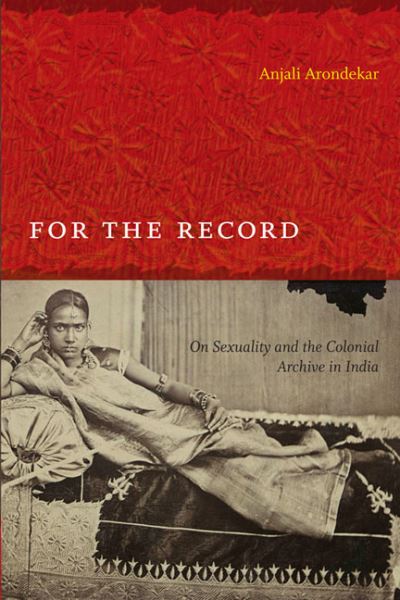
The logic and the interpretive resources of For the Record arise out of two entangled and minoritized historiographies: one in South Asian studies and the other in queer/sexuality studies. Focusing on late colonial India, Arondekar examines the spectacularization of sexuality in anthropology, law, literature, and pornography from 1843 until 1920.
By turning to materials and/or locations that are familiar to most scholars of queer and subaltern studies, Arondekar considers sexuality at the center of the colonial archive rather than at its margins. Each chapter addresses a form of archival loss, troped either in a language of disappearance or paucity, simulacrum or detritus: from Richard Burton's missing report on male brothels in KarÁchi (1845) to a failed sodomy prosecution in Northern India, Queen Empress v.
Khairati (1884), and from the ubiquitous India-rubber dildos found in colonial pornography of the mid-to-late nineteenth century to the archival detritus of Kipling's stories about the Indian Mutiny of 1857.
| ISBN: | 9780822345336 |
| Publication date: | 15th September 2009 |
| Author: | Anjali R Arondekar |
| Publisher: | Duke University Press |
| Format: | Paperback |
| Pagination: | 216 pages |
| Series: | Next Wave : New Directions in Women's Studies |
| Genres: |
Asian history LGBTQ+ Studies / topics |
Anjali Arondekar considers the relationship between sexuality and the colonial archive by posing the following questions: Why does sexuality (still) seek its truth in the historical archive? What are the spatial and temporal logics that compel such a return?
For the Record features in the following genres: Asian history, LGBTQ+ Studies / topics
Hardback, Paperback. Not Available.
For the Record was written by Anjali R Arondekar and published by Duke University Press
For the Record has 216 pages
Yes it is part of Next Wave : New Directions in Women's Studies series