

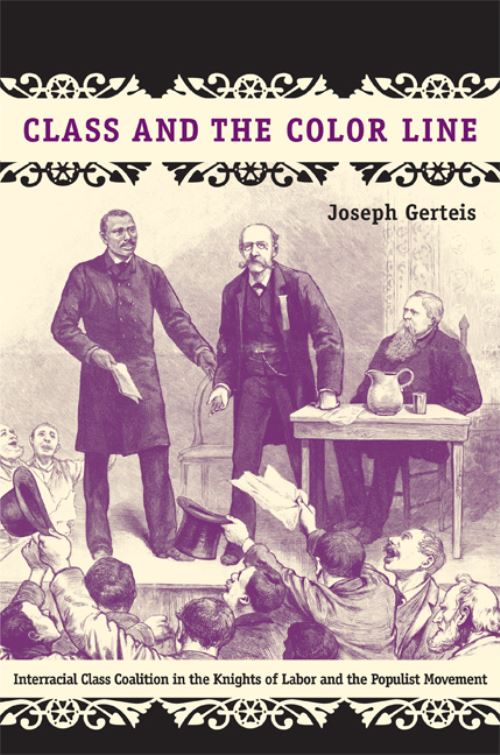
While scholars have long debated whether the Knights and the Populists were genuine in their efforts to cross the color line, Joseph Gerteis shifts attention from that question to those of how, where, and when the movements' organizers drew racial boundaries. Arguing that the movements were simultaneously racially inclusive and exclusive, Gerteis explores the connections between race and the movements' economic and political interests in their cultural claims and in the dynamics of local organizing.
Interpreting data from the central journals of the Knights of Labor and the two major Populist organizations, the Farmers' Alliance and the People's Party, Gerteis explains how the movements made sense of the tangled connections between race, class, and republican citizenship. He considers how these collective narratives motivated action in specific contexts: in Richmond and Atlanta in the case of the Knights of Labor, and in Virginia and Georgia in that of the Populists.
Gerteis demonstrates that the movements' collective narratives galvanized interracial organizing to varying degrees in different settings. At the same time, he illuminates the ways that interracial organizing was enabled or constrained by local material, political, and social conditions.
| ISBN: | 9780822342243 |
| Publication date: | 24th October 2007 |
| Author: | Joseph Gerteis |
| Publisher: | Duke University Press |
| Format: | Paperback |
| Pagination: | 304 pages |
| Series: | Politics, History, and Culture |
| Genres: |
History of the Americas Ethnic studies Social and cultural history |
A lauded contribution to historical sociology, Class and the Color Line is an analysis of social-movement organizing across racial lines in the American South during the 1880s and the 1890s. The Knights of Labor and the Populists were the largest and most influential movements of their day, as well as the first to undertake large-scale organizing in the former Confederate states, where they attempted to recruit African Americans as fellow workers and voters.
Class and the Color Line features in the following genres: History of the Americas, Ethnic studies, Social and cultural history
Paperback, Hardback. Not Available.
Class and the Color Line was written by Joseph Gerteis and published by Duke University Press
Class and the Color Line has 304 pages
Yes it is part of Politics, History, and Culture series