

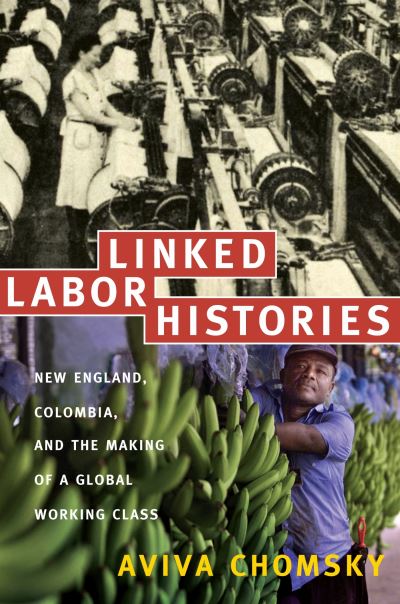
Chomsky examines labor and management at two early-twentieth-century Massachusetts factories: one that transformed the global textile industry by exporting looms around the world, and another that was the site of a model program of labor-management collaboration in the 1920s. She follows the path of the textile industry from New England, first to the U.S.
South, and then to Puerto Rico, Japan, Mexico, Central America, the Caribbean, and Colombia. She considers how towns in Rhode Island and Massachusetts began to import Colombian workers as they struggled to keep their remaining textile factories going. Most of the workers eventually landed in service jobs: cleaning houses, caring for elders, washing dishes.
Focusing on Colombia between the 1960s and the present, Chomsky looks at the UrabÁ banana export region, where violence against organized labor has been particularly acute, and, through a discussion of the AFL-CIO's activities in Colombia, she explores the thorny question of U.S. union involvement in foreign policy.
In the 1980s, two U.S. coal mining companies began to shift their operations to Colombia, where they opened two of the largest open-pit coal mines in the world. Chomsky assesses how different groups, especially labor unions in both countries, were affected. Linked Labor Histories suggests that economic integration among regions often exacerbates regional inequalities rather than ameliorating them.
| ISBN: | 9780822341734 |
| Publication date: | 1st April 2008 |
| Author: | Aviva Chomsky |
| Publisher: | Duke University Press |
| Format: | Hardback |
| Pagination: | 397 pages |
| Series: | American Encounters/global Interactions |
| Genres: |
History of the Americas |
Exploring globalization from a labor history perspective, Aviva Chomsky provides historically grounded analyses of migration, labor-management collaboration, and the mobility of capital. She illuminates the dynamics of these movements through case studies set mostly in New England and Colombia.
Linked Labor Histories features in the following genres: History of the Americas
Hardback, Paperback. Not Available.
Linked Labor Histories was written by Aviva Chomsky and published by Duke University Press
Linked Labor Histories has 397 pages
Yes it is part of American Encounters/global Interactions series