

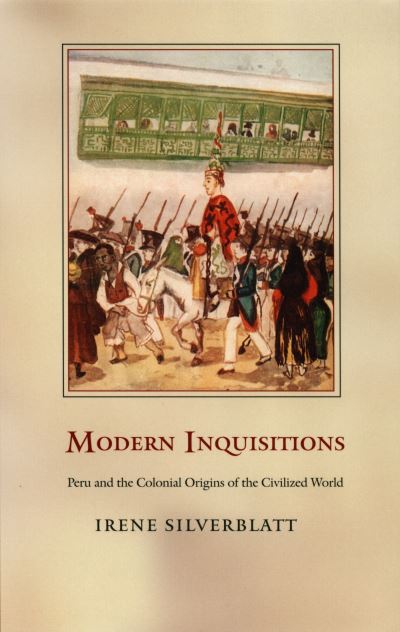
Drawing on extensive research in Peruvian and Spanish archives, Silverblatt uses church records, evangelizing sermons, and missionary guides to explore how the emerging modern world was built, experienced, and understood by colonists, native peoples, and Inquisition officials: Early missionaries preached about world history and about the races and nations that inhabited the globe; Inquisitors, able bureaucrats, defined who was a legitimate Spaniard as they executed heretics for “reasons of state”; the “stained blood” of Indians, blacks, and descendants of Jews and Moors was said to cause their deficient character; and native Peruvians began to call themselves Indian.
In dialogue with Arendt and other theorists of modernity, Silverblatt shows that the modern world's underside is tied to its origins in colonialism and to its capacity to rationalize violence. Modern Inquisitions forces the reader to confront the idea that the Inquisition was not only a product of the modern world of the sixteenth and seventeenth centuries, but party to the creation of the civilized world we know today.
| ISBN: | 9780822334064 |
| Publication date: | 15th January 2005 |
| Author: | Irene Silverblatt |
| Publisher: | Duke University Press |
| Format: | Hardback |
| Pagination: | 299 pages |
| Series: | Latin America Otherwise |
| Genres: |
History of religion |
Trying to understand how “civilized” people could embrace fascism, Hannah Arendt searched for a precedent in modern Western history. She found it in nineteenth-century colonialism, with its mix of bureaucratic rule, racial superiority, and appeals to rationality.
Modern Inquisitions features in the following genres: History of religion
Hardback, Paperback. Not Available.
Modern Inquisitions was written by Irene Silverblatt and published by Duke University Press
Modern Inquisitions has 299 pages
Yes it is part of Latin America Otherwise series