

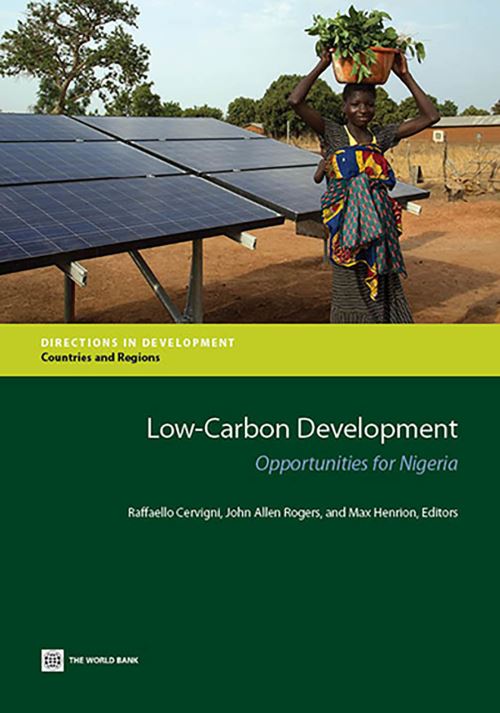
The Federal Government of Nigeria has adopted an ambitious strategy to make Nigeria the world's 20th largest economy by 2020. Sustaining such a pace of growth will entail rapid expansion of the level of activity in key carbon-emitting sectors, such as power, oil and gas, agriculture and transport. In the absence of policies to accompany economic growth with a reduced carbon foot-print, emissions of greenhouse gases could more than double in the next two decades.
This study finds that there are several options for Nigeria to achieve the development objectives of vision 20:
| ISBN: | 9780821399255 |
| Publication date: | 30th July 2013 |
| Author: | Raffaello Cervigni, John Allen Rogers, Max Henrion |
| Publisher: | World Bank Publications an imprint of The World Bank |
| Format: | Paperback |
| Pagination: | 186 pages |
| Series: | Directions in Development - Countries and Regions |
| Genres: |
Environmental economics |
The Federal Government of Nigeria has adopted an ambitious strategy to make Nigeria the world's 20th largest economy by 2020. Sustaining such a pace of growth will entail rapid expansion of the level of activity in key carbon-emitting sectors, such as power, oil and gas, agriculture and transport.
Low-Carbon Development features in the following genres: Environmental economics
Paperback. Not Available.
Low-Carbon Development was written by Raffaello Cervigni, John Allen Rogers, Max Henrion and published by World Bank Publications an imprint of The World Bank
Low-Carbon Development has 186 pages
Yes it is part of Directions in Development - Countries and Regions series