

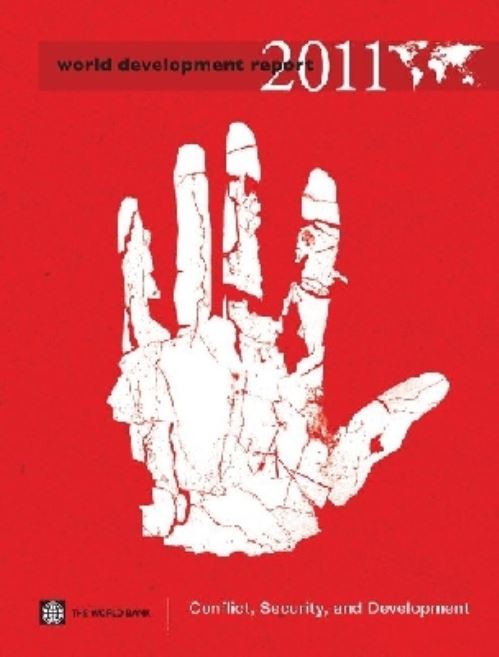
With more than 1.5 billion people living in countries affected by conflict, the World Development Report 2011 (WDR) looks into the changing nature of violence in the 21st century. Interstate and civil wars characterized violent conflict in the last century; more pronounced today is violence linked to local disputes, political repression, and organized crime.
The report underlines the negative impact of persistent conflict on a country's or a region's development prospects, and notes that no low income, conflict-affected state has yet achieved a single Millennium Development Goal. The risk of major violence is greatest when high levels of stress combine with weak and illegitimate national institutions.
Societies are vulnerable when their institutions are unable to protect citizens from abuse, or to provide equitable access to justice and to economic opportunity. These vulnerabilities are exacerbated in countries with high youth unemployment, growing income inequality, and perceptible injustice. Externally driven events such as infiltration by foreign combatants, the presence of trafficking networks, or economic shocks add to the stresses that can provoke violence.
The WDR 2011 draws on the experiences of countries that have successfully managed to transition away from repetitive violence, pointing to a specific need to prioritize actions that build confidence between states and citizens, and develop institutions that can provide security, justice, and jobs. Government capacity is central, but technical competence alone is insufficient: institutions and programs must be accountable to their citizens if they are to acquire legitimacy.
Impunity, corruption, and human rights abuses undermine confidence between states and citizens and increase the risks of violence. Building resilient institutions occurs in multiple transitions over a generation, and does not mean converging on western institutional models.
The WDR 2011 draws together lessons from national reformers escaping from repetitive cycles of violence. It advocates a greater focus on continuous preventive action, balancing a sometimes excessive concentration on postconflict reconstruction. The report is based on new research, case studies, and extensive consultations with leaders and other actors throughout the world.
It proposes a toolkit of options for addressing violence that can be adapted to local contexts, as well as new directions for international policy intended to improve support for national reformers and to tackle stresses that emanate from global or regional trends beyond any one country's control.
| ISBN: | 9780821384398 |
| Publication date: | 30th May 2011 |
| Author: | |
| Publisher: | World Bank Publications an imprint of World Bank Group Publications |
| Format: | Paperback |
| Pagination: | 384 pages |
| Series: | World Development Report |
| Genres: |
Development economics and emerging economies |
With more than 1.5 billion people living in countries affected by conflict, the World Development Report 2011 (WDR) looks into the changing nature of violence in the 21st century. Interstate and civil wars characterized violent conflict in the last century; more pronounced today is violence linked to local disputes, political repression, and organized crime.
World Development Report 2011 features in the following genres: Development economics and emerging economies
Hardback, Paperback. Not Available.
World Development Report 2011 was written by and published by World Bank Publications an imprint of World Bank Group Publications
World Development Report 2011 has 384 pages
Yes it is part of World Development Report series