

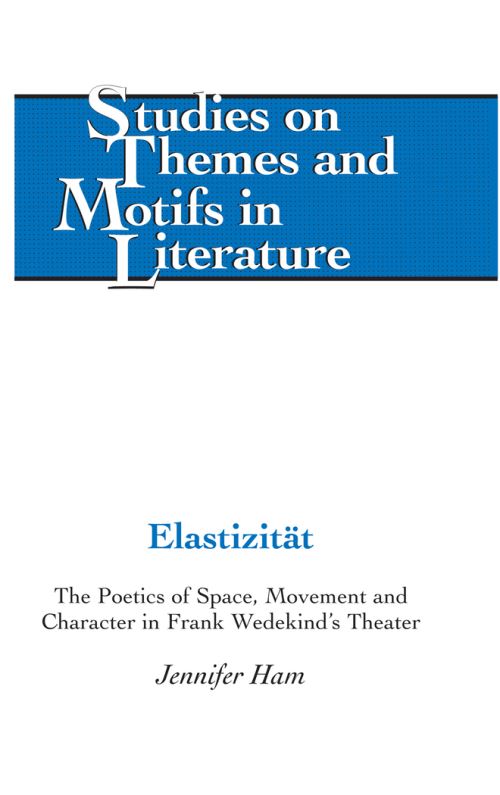
Frequenting circuses in Paris and Berlin, Frank Wedekind, best known for Spring Awakening and the Lulu plays, learned that trapeze artists and tightrope walkers rely on different artificial reference points in space, in order to maintain their balance and orient themselves and to create their own sensorial and phenomenal worlds. This lesson in radical perspectivism and constructivism is a key to Wedekind's practice as a playwright, and it links the Munich dramatist's work to the thought of Schopenhauer, who first used the term Elastizität in a philosophical sense; Darwin, who considered adaptability to be a primordial characteristic of life; Nietzsche, whose commentary on acrobats in Also sprach Zarathustra announces the Overman; and Freud, who used the term to describe the reactive, conservative nature of the instincts.
Taking Elastizität and the modern notion of adaptability as its point of departure, this book explores Wedekind's construction of space, movement and character in his plays, pantomimes, ballets and theoretical writings as a means of understanding both the structural consistencies and the ideological incongruities that permeate his fiction and nearly all layers of his works. This work also disengages Wedekind from traditional discussions of the dramatist as controversial social critic and reintroduces him into more productive discussions of his connection to nineteenth-century philosophical debates surrounding determinism, dualism and perception, on the one hand, and modern notions of risk, danger and precarity on the other.
| ISBN: | 9780820430836 |
| Publication date: | 31st October 2012 |
| Author: | Jennifer Ham |
| Publisher: | Peter Lang an imprint of Peter Lang Inc., International Academic Publishers |
| Format: | Hardback |
| Pagination: | 214 pages |
| Series: | Studies on Themes and Motifs in Literature |
| Genres: |
Literary studies: c 1800 to c 1900 Literary studies: c 1900 to c 2000 Theatre: technical and background skills Literary studies: plays and playwrights |
Frequenting circuses in Paris and Berlin, Frank Wedekind, best known for Spring Awakening and the Lulu plays, learned that trapeze artists and tightrope walkers rely on different artificial reference points in space, in order to maintain their balance and orient themselves and to create their own sensorial and phenomenal worlds. This lesson in radical perspectivism and constructivism is a key to Wedekind's practice as a playwright, and it links the Munich dramatist's work to the thought of Schopenhauer, who first used the term Elastizität in a philosophical sense; Darwin, who considered adaptability to be a primordial characteristic of life; Nietzsche, whose commentary on acrobats in Also sprach Zarathustra announces the Overman; and Freud, who used the term to describe the reactive, conservative nature of the instincts.
Elastizität features in the following genres: Literary studies: c 1800 to c 1900, Literary studies: c 1900 to c 2000, Theatre: technical and background skills, Literary studies: plays and playwrights
Hardback. Not Available.
Elastizität was written by Jennifer Ham and published by Peter Lang an imprint of Peter Lang Inc., International Academic Publishers
Elastizität has 214 pages
Yes it is part of Studies on Themes and Motifs in Literature series