

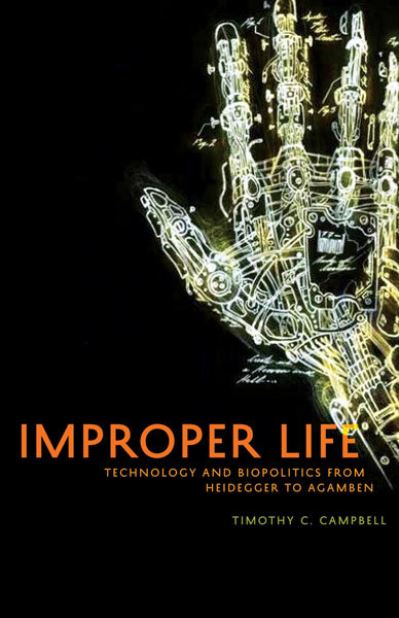
Has biopolitics actually become thanatopolitics, a field of study obsessed with death? Is there something about the nature of biopolitical thought today that makes it impossible to deploy affirmatively? If this is true, what can life-minded thinkers put forward as the merits of biopolitical reflection? These questions drive Improper Life, Timothy C. Campbell's dexterous inquiry-as-intervention.
Campbell argues that a "crypto-thanatopolitics" can be teased out of Heidegger's critique of technology and that some of the leading scholars of biopolitics-including Michel Foucault, Giorgio Agamben, and Peter Sloterdijk-have been substantively influenced by Heidegger's thought, particularly his reading of proper and improper writing. In fact, Campbell shows how all of these philosophers have pointed toward a tragic, thanatopolitical destination as somehow an inevitable result of technology. But in Improper Life he articulates a corrective biopolitics that can begin with rereadings of Foucault (especially his late work regarding the care and technologies of the self), Freud (notably his writings on the drives and negation), and Gilles Deleuze (particularly in the relation of attention to aesthetics).
Throughout Improper Life, Campbell insists that biopolitics can become more positive and productively asserts an affirmative techne not thought through thanatos but rather practiced through bÍos.
| ISBN: | 9780816674657 |
| Publication date: | 28th October 2011 |
| Author: | Timothy C Campbell |
| Publisher: | University of Minnesota Press an imprint of University Of Minnesota Press |
| Format: | Paperback |
| Pagination: | 232 pages |
| Series: | Posthumanities |
| Genres: |
Social and political philosophy Impact of science and technology on society |
Has biopolitics actually become thanatopolitics, a field of study obsessed with death? Is there something about the nature of biopolitical thought today that makes it impossible to deploy affirmatively?
Improper Life features in the following genres: Social and political philosophy, Impact of science and technology on society
Paperback. Not Available.
Improper Life was written by Timothy C Campbell and published by University of Minnesota Press an imprint of University Of Minnesota Press
Improper Life has 232 pages
Yes it is part of Posthumanities series