

The case of Bengal illustrates the interaction of colonialism and modernity.
Bengal was the first “modern” province in India-the first, that is, to undergo a forced encounter with Western modernity. Beginning with this premise, the writers in Texts of Power consider what the case of Bengal says about the workings of Western modernity in a colonial setting.
A truly interdisciplinary effort, this collection probes questions of pedagogy, nationalism, and gender. Among the subjects explored are colonialist and nationalist surveillance of Bengali literature; the disposition of the nation's art; the politics of child-rearing; the mapping of Calcutta; and the disciplining of historical memory. By applying the theoretical insights of recent historical and cultural studies to the specific circumstances of Bengal, the authors develop a new approach to Indian intellectual and cultural history. Their work makes a significant contribution to our understanding of contemporary intellectual modernity.Contributors: Pradip Kumar Bose, Keya Dasgupta, Tapati Guha-Thakurta, all at the Centre for Studies in Social Sciences, Calcutta; Tapti Roy, Maharani Kashiswari College, Calcutta; Ranabir Samaddar, Maulana Azad Institute of Asian Studies.| ISBN: | 9780816626878 |
| Publication date: | 7th November 1995 |
| Author: | Partha Chatterjee |
| Publisher: | University of Minnesota Press an imprint of University Of Minnesota Press |
| Format: | Paperback |
| Pagination: | 232 pages |
| Genres: |
Anthropology |
The case of Bengal illustrates the interaction of colonialism and modernity.Bengal was the first “modern” province in India-the first, that is, to undergo a forced encounter with Western modernity. Beginning with this premise, the writers in Texts of Power consider what the case of Bengal says about the workings of Western modernity in a colonial setting.
Texts of Power features in the following genres: Anthropology
Paperback. Not Available.
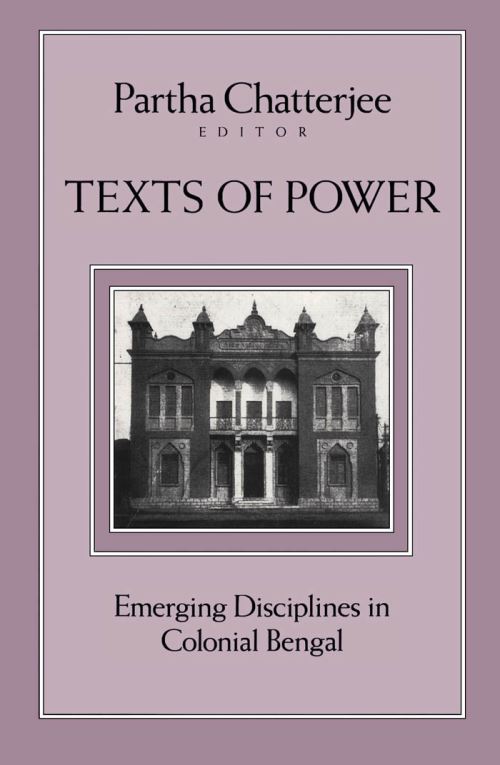
Texts of Power was written by Partha Chatterjee and published by University of Minnesota Press an imprint of University Of Minnesota Press
Texts of Power has 232 pages