

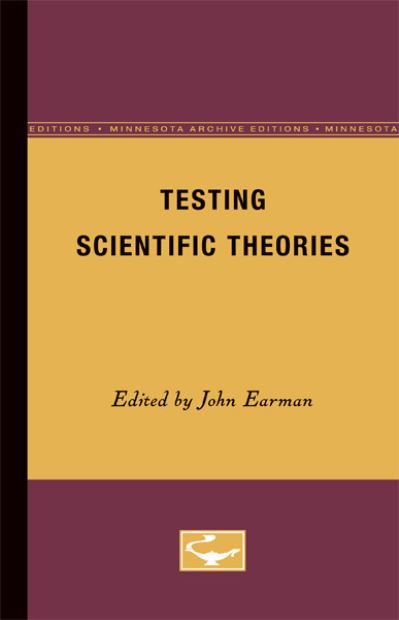
Testing Scientific Theories was first published in 1984. Minnesota Archive Editions uses digital technology to make long-unavailable books once again accessible, and are published unaltered from the original University of Minnesota Press editions.
Since much of a scientist's work consists of constructing arguments to show how experiments and observation bear on a particular theory, the methodologies of theory testing and their philosophical underpinnings are of vital concern to philosophers of science. Confirmation of scientific theories is the topic of Clark Glymour's important book Theory and Evidence,published in 1980.
His negative thesis is that the two most widely discussed accounts of the methodology of theory testing - hypothetico-deductivism and Bayesianism - are flawed. The issues Glymour raises and his alternative "bootstrapping" method provided the focus for a conference sponsored by the Minnesota Center for Philosophy of Science and for this book.
As editor John Earman says in his preface, the papers presented in Testing Scientific Theories germinate so many new ideas that philosophers of science will reap the harvest for years to come.
Topics covered include a discussion of Glymour's bootstrapping theory of confirmation, the Bayesian perspective and the problems of old evidence, evidence and explanation, historical case studies, alternative views on testing theories, and testing particular theories, including psychoanalytic hypotheses and hypotheses about the completeness of the fossil record.
| ISBN: | 9780816611591 |
| Publication date: | 14th February 1984 |
| Author: | John Earman |
| Publisher: | University of Minnesota Press |
| Format: | Paperback |
| Pagination: | 496 pages |
| Series: | Minnesota Studies in the Philosophy of Science |
| Genres: |
Impact of science and technology on society |
Testing Scientific Theories was first published in 1984. Minnesota Archive Editions uses digital technology to make long-unavailable books once again accessible, and are published unaltered from the original University of Minnesota Press editions.Since much of a scientist's work consists of constructing arguments to show how experiments and observation bear on a particular theory, the methodologies of theory testing and their philosophical underpinnings are of vital concern to philosophers of science.
Testing Scientific Theories features in the following genres: Impact of science and technology on society
Paperback. Not Available.
Testing Scientific Theories was written by John Earman and published by University of Minnesota Press
Testing Scientific Theories has 496 pages
Yes it is part of Minnesota Studies in the Philosophy of Science series