

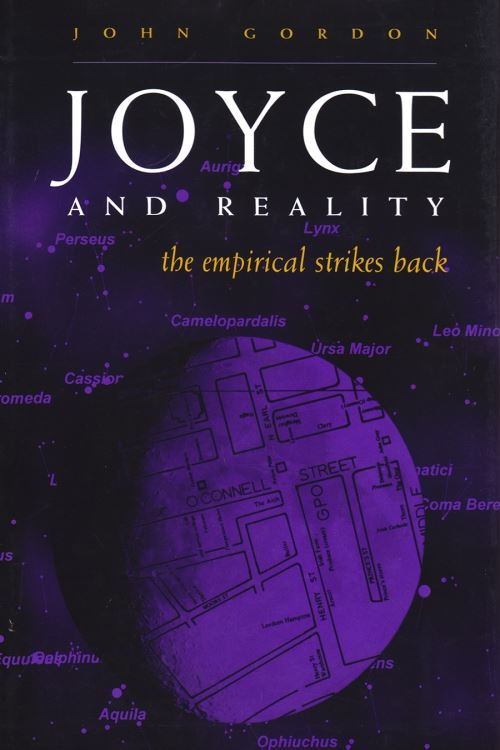
Joyce was a realist, but his reality was not ours, writes John Gordon in his new book. Here, he maintains that the shifting styles and techniques of Joyce's works is a function of two interacting realities - the external reality of a particular time and place and the internal reality of a character's mental state. In making this case Gordon offers up a number of new readings: how Stephen Dedalus conceives and composes his villanelle; why the Dubliners story about Little Chandler is titled ""A Little Cloud""; why MacDowell suddenly appears and disappears; what is happening when Leopold Bloom looks for two minutes at a beer bottle's label; why the triangle etched at the center of Finnegans Wake doubles itself and grows a pair of circles; why the next to last chapter of Ulysses has, by far, the book's highest incidence of the letter C; and who is the man in the macintosh.
Gordon, whose authoritative Finnegans Wake: A Plot Summary received critical acclaim and is considered one of the standard references, revises - and challenges - the received version of that reality. For instance, Joyce features ghost visitations, telepathy, and other para-normal phenomena not as ""flights into fantasy"" but because he believed in the real possibility of such occurrences.
| ISBN: | 9780815630197 |
| Publication date: | 1st May 2004 |
| Author: | John Gordon |
| Publisher: | Syracuse University Press |
| Format: | Hardback |
| Pagination: | 338 pages |
| Series: | Irish Studies |
| Genres: |
Literature: history and criticism |
Joyce was a realist, but his reality was not ours, writes John Gordon in his new book. Here, he maintains that the shifting styles and techniques of Joyce's works is a function of two interacting realities - the external reality of a particular time and place and the internal reality of a character's mental state.
Joyce and Reality features in the following genres: Literature: history and criticism
Hardback. Not Available.
Joyce and Reality was written by John Gordon and published by Syracuse University Press
Joyce and Reality has 338 pages
Yes it is part of Irish Studies series