

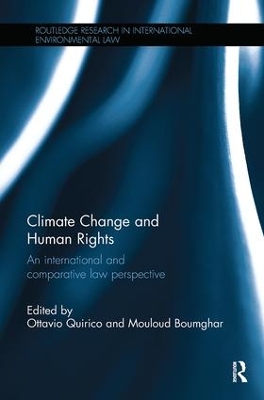
Do anthropogenic greenhouse gas emissions affect human rights? Should fundamental rights constrain climate policies? Scientific evidence demonstrates that anthropogenic greenhouse gas emissions contribute to increasing atmospheric temperatures, soon passing the compromising threshold of 2° C.
Consequences such as Typhoon Haiyan prove that climate alteration has the potential to significantly impair basic human needs. Although the United Nations Framework Convention on Climate Change and human rights regulatory regimes have so far proceeded separately, awareness is arising about their reciprocal implications. Based on tripartite fundamental obligations, this volume explores the relationship between climate change and interdependent human rights, through the lens of an international and comparative perspective.
Along the lines of the metaphor of the ‘wall’, the research ultimately investigates the possibility of overcoming the divide between universal rights and climate change, and underlying barriers. This book aims to be a useful resource not only for practitioners, policymakers, academics, and students in international, comparative, environmental law and politics and human rights, but also for the wider public.
| ISBN: | 9780815355342 |
| Publication date: | 21st December 2017 |
| Author: | Ottavio Quirico |
| Publisher: | Routledge an imprint of Taylor & Francis Inc |
| Format: | Paperback |
| Pagination: | 424 pages |
| Series: | Routledge Research in International Environmental Law |
| Genres: |
Public international law Environment law Public international law: human rights International law Environmental science, engineering and technology Human rights, civil rights Politics and government |
Do anthropogenic greenhouse gas emissions affect human rights? Should fundamental rights constrain climate policies?
Climate Change and Human Rights features in the following genres: Public international law, Environment law, Public international law: human rights, International law, Environmental science, engineering and technology, Human rights, civil rights, Politics and government
Paperback, Hardback. £50.39, down from the £55.99 cover price. Not Available.
Climate Change and Human Rights was written by Ottavio Quirico and published by Routledge an imprint of Taylor & Francis Inc
Climate Change and Human Rights has 424 pages
Yes it is part of Routledge Research in International Environmental Law series
£50.39, reduced from £55.99. Not Available.