

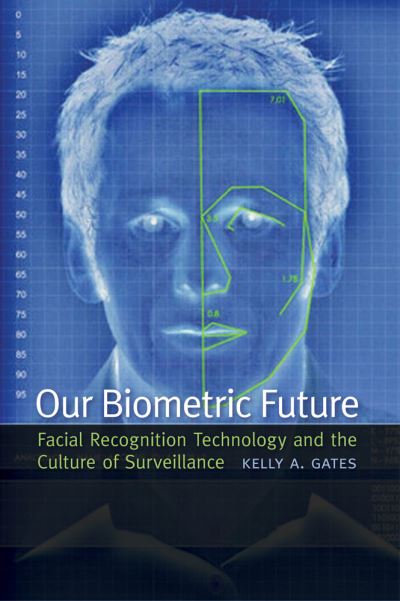
Since the 1960s, a significant effort has been underway to program computers to "see" the human face—to develop automated systems for identifying faces and distinguishing them from one another-commonly known as Facial Recognition Technology. While computer scientists are developing FRT in order to design more intelligent and interactive machines, businesses and states agencies view the technology as uniquely suited for "smart" surveillance-systems that automate the labor of monitoring in order to increase their efficacy and spread their reach.
Tracking this technological pursuit, Our Biometric Future identifies FRT as a prime example of the failed technocratic approach to governance, where new technologies are pursued as shortsighted solutions to complex social problems. Culling news stories, press releases, policy statements, PR kits and other materials, Kelly Gates provides evidence that, instead of providing more security for more people, the pursuit of FRT is being driven by the priorities of corporations, law enforcement and state security agencies, all convinced of the technology's necessity and unhindered by its complicated and potentially destructive social consequences. By focusing on the politics of developing and deploying these technologies, Our Biometric Future argues not for the inevitability of a particular technological future, but for its profound contingency and contestability.
| ISBN: | 9780814732090 |
| Publication date: | 23rd January 2011 |
| Author: | Kelly Gates |
| Publisher: | New York University Press an imprint of New York University |
| Format: | Hardback |
| Pagination: | 263 pages |
| Series: | Critical Cultural Communication |
| Genres: |
Media studies Applied optics |
Since the 1960s, a significant effort has been underway to program computers to "see" the human face—to develop automated systems for identifying faces and distinguishing them from one another-commonly known as Facial Recognition Technology. While computer scientists are developing FRT in order to design more intelligent and interactive machines, businesses and states agencies view the technology as uniquely suited for "smart" surveillance-systems that automate the labor of monitoring in order to increase their efficacy and spread their reach.
Our Biometric Future features in the following genres: Media studies, Applied optics
Paperback, Hardback. Not Available.
Our Biometric Future was written by Kelly Gates and published by New York University Press an imprint of New York University
Our Biometric Future has 263 pages
Yes it is part of Critical Cultural Communication series