

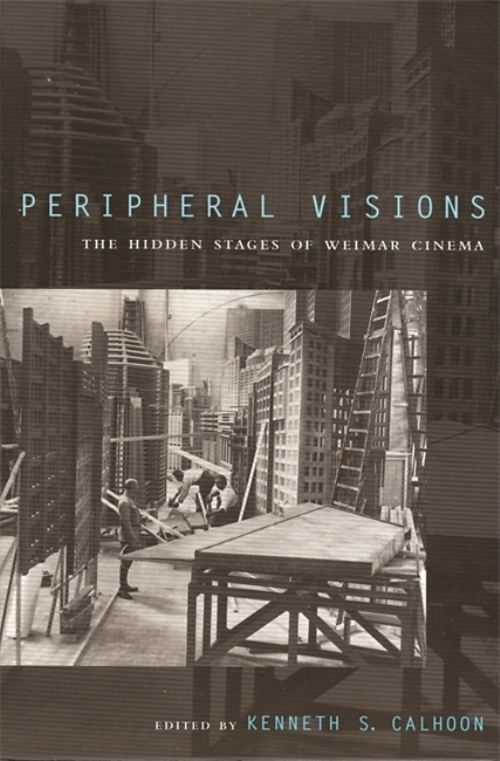
The title of this collection echoes Siegfried Kracauer's statement that the lavish movie palaces of 1920s Germany served to stimulate peripheral vision and thus prevent the audience from being absorbed by the spectacle itself. In consideration of questions concerning spatial transformations in and around Weimar cinema, the eight essays in this volume, though some more explicitly than others, have Kracauer as their interlocutor.
The first major critic of classic German cinema, Kracauer is patron of the optics that seeks insight on the periphery, inviting the analysis of those other spaces that are implicated, if not present, in the films themselves. The films treated in this volume include such Expressionist mainstays as Lang's ""Metropolis"" and Murnau's ""Nosferatu"" as well as generally less familar works such as Ruttman's ""Berlin, Symphony of a City"", Jessner's ""Backstairs"", Berger's ""Day and Night"" and the mountain films of Fanck and Riefenstahl.
Among the ""hidden stages"" analyzed are amusement parks, carnivals, department stores, train compartments, city streets, the womb, the theatre, the chamber, basement apartments - and ultimately Neubabelsberg, the gargantuan studio-complex near Berlin where so many of these peripheral spaces came to be simulated. With references that range from set architecture to Christmas celebrations, from the poetry of Rilke to chamber music, from the introduction of sound to Macy's parades, and from an ""urban unconscious"" to a ""cinematic sublime"", ""Peripheral Visions"" is a collection that should be of interest to students and scholars of film and German cultural studies.
| ISBN: | 9780814329283 |
| Publication date: | 31st July 2001 |
| Author: | Kenneth Scott Calhoon |
| Publisher: | Wayne State University Press |
| Format: | Paperback |
| Pagination: | 198 pages |
| Series: | Kritik |
| Genres: |
Film history, theory or criticism Cultural studies History: specific events and topics |
The title of this collection echoes Siegfried Kracauer's statement that the lavish movie palaces of 1920s Germany served to stimulate peripheral vision and thus prevent the audience from being absorbed by the spectacle itself. In consideration of questions concerning spatial transformations in and around Weimar cinema, the eight essays in this volume, though some more explicitly than others, have Kracauer as their interlocutor.
Peripheral Visions features in the following genres: Film history, theory or criticism, Cultural studies, History: specific events and topics
Paperback. Not Available.
Peripheral Visions was written by Kenneth Scott Calhoon and published by Wayne State University Press
Peripheral Visions has 198 pages
Yes it is part of Kritik series