

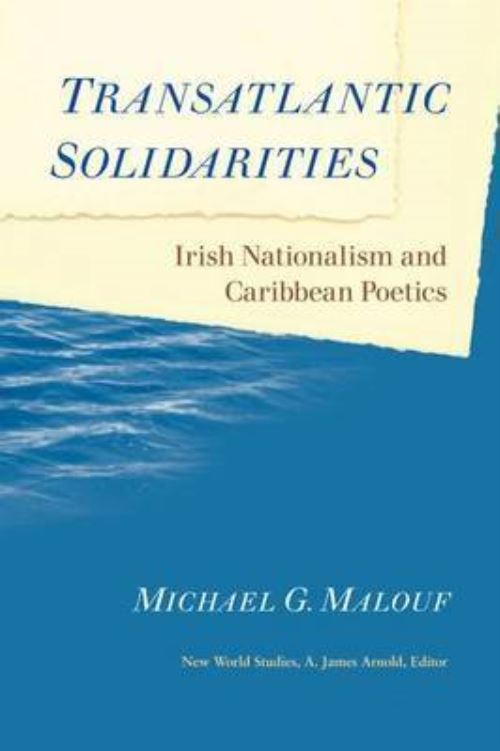
Despite their prominent place in twentieth-century literature in English, novelists and poets from Ireland and the anglophone Caribbean have long been separated by literary histories in which they are either representing a local, nationalist tradition or functioning within an international movement such as modernism or postcolonialism. Redressing this either/or framework, Michael Malouf recognizes an integral history shared by these two poetic and political traditions, arising from their common transatlantic history in relation to the British empire and their common spaces of migration in New York and London.
In examining these cross-cultural exchanges, he reconsiders our conception of transatlantic space and offers a revised conception of solidarity that is much more diverse than previously assumed. Offering a new narrative of cultural influence and performance, this work specifically demonstrates the formative role of Irish nationalist discourse - expressed in the works of Eamon de Valera, George Bernard Shaw, and James Joyce - in the transnational political and aesthetic self-fashioning of three influential Caribbean figures: Marcus Garvey, Claude McKay, and Derek Walcott.
It provides both an innovative historical and literary methodology for reading cross-cultural relations between two postcolonial cultures and a literary and political history that can account for the recent diversity of the field of anglophone world literature.
| ISBN: | 9780813927800 |
| Publication date: | 28th February 2009 |
| Author: | Michael G Malouf |
| Publisher: | University of Virginia Press |
| Format: | Paperback |
| Pagination: | 280 pages |
| Series: | New World Studies |
| Genres: |
Literary studies: c 1900 to c 2000 |
Despite their prominent place in twentieth-century literature in English, novelists and poets from Ireland and the anglophone Caribbean have long been separated by literary histories in which they are either representing a local, nationalist tradition or functioning within an international movement such as modernism or postcolonialism. Redressing this either/or framework, Michael Malouf recognizes an integral history shared by these two poetic and political traditions, arising from their common transatlantic history in relation to the British empire and their common spaces of migration in New York and London.
Transatlantic Solidarities features in the following genres: Literary studies: c 1900 to c 2000
Hardback, Paperback. Not Available.
Transatlantic Solidarities was written by Michael G Malouf and published by University of Virginia Press
Transatlantic Solidarities has 280 pages
Yes it is part of New World Studies series