

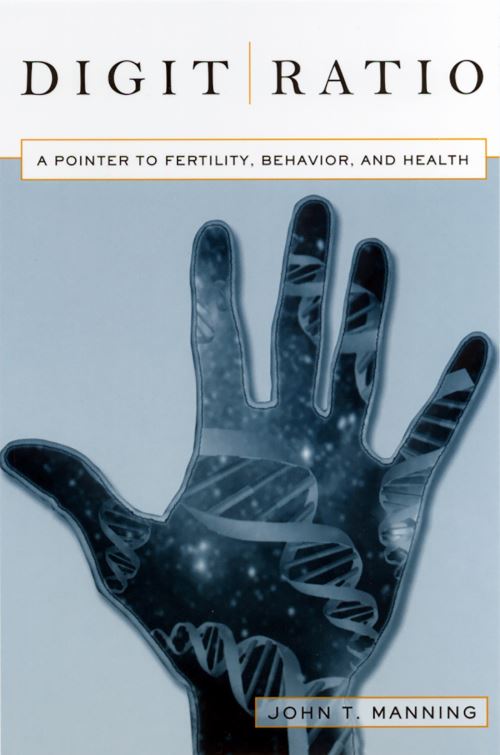
It has been known for more than a century that men and women tend to differ in the relative lengths of their index (2D) and ring (4D) fingers, which upon casual observation seem fairly symmetrical. Men on average have fourth digits longer than their second digits, while women typically have the opposite. Digit ratios are unique in that they are fixed before birth, while other sexually dimorphic variables are fixed after puberty, and the same genes that control for finger length also control the development of the sex organs. The 2D:4D ratio is the only prenatal sexually dimorphic trait that measurably explains conditions linking testosterone, estrogen, and human development; the study of the ratio broadens our view of human ability, talent, behavior, disposition, health, and fertility. In this book, Manning presents evidence for how 2D:4D correlates with traits ranging from sperm counts, family size, musical genius, and sporting prowess, to autism, depression, homosexuality, heart attacks, and breast cancer, traits that are all linked with early exposure to sex hormones.
| ISBN: | 9780813530307 |
| Publication date: | 1st January 2002 |
| Author: | John T Manning |
| Publisher: | Rutgers University Press |
| Format: | Paperback |
| Pagination: | 173 pages |
| Series: | The Rutgers Series in Human Evolution |
| Genres: |
Popular medicine and health |
Could the length of your fingers indicate a predisposition to breast cancer? Or musical genius?
Digit Ratio features in the following genres: Popular medicine and health
Paperback. Not Available.
Digit Ratio was written by John T Manning and published by Rutgers University Press
Digit Ratio has 173 pages
Yes it is part of The Rutgers Series in Human Evolution series