

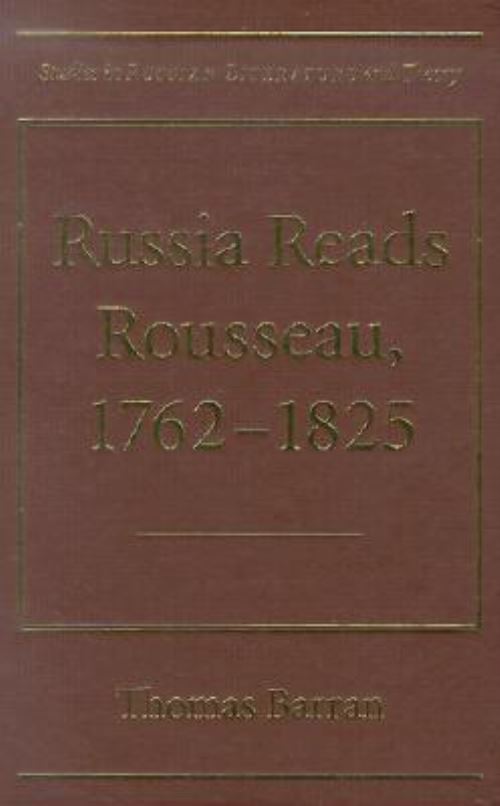
Whether seen as a literary genius, educator, dedicated patriot, misanthrope, scoundrel, proto-Jacobin, or out-right lunatic, Jean-Jacques Rousseau left a bewildering pattern on the Russian intellectual landscape. Fully tracing this pattern for the first time, this book reveals the nature and extent of Rousseau's initial influence in Russia, as well as a great deal about the social, cultural, and political contexts in which he was so variously understood by the Russians.
Thomas Barran shows here how Rousseau quickly became a model of the visionary to the Russians. Russia Reads Rousseau makes explicit the selectivity, ambivalence, and energy with which Russians accepted Rousseau's works. Barran's book provides a refreshing corrective to the numerous misinterpretations by both Russian authors who introduced Rousseau to Russia and scholars who have analyzed the Russian reception of Rousseau.
Mapping Rousseau's varied and extensive influence, Barran considers major writers such as Denis Fonvizin, Nikolai Novikov, Nikolai Karamzin, and Aleksandr Pushkin, as well as lesser known or forgotten figures. He shows how Rousseau's works were Russianized in numerous ways, as translations, adaptations, and commentary, and in editors' or translators' introductions, fictional or biographical accounts, poetry, prose, and even footnotes.
Barran's book should prove indispensable to an understanding of the writer and his Russian readers.
| ISBN: | 9780810118447 |
| Publication date: | 30th August 2002 |
| Author: | Thomas Paul Barran |
| Publisher: | Northwestern University Press |
| Format: | Hardback |
| Pagination: | 404 pages |
| Series: | Studies in Russian Literature and Theory |
| Genres: |
Literary studies: general History of ideas Literary studies: c 1800 to c 1900 European history Philosophical traditions and schools of thought History |
Whether seen as a literary genius, educator, dedicated patriot, misanthrope, scoundrel, proto-Jacobin, or out-right lunatic, Jean-Jacques Rousseau left a bewildering pattern on the Russian intellectual landscape. Fully tracing this pattern for the first time, this book reveals the nature and extent of Rousseau's initial influence in Russia, as well as a great deal about the social, cultural, and political contexts in which he was so variously understood by the Russians.
Russia Reads Rousseau, 1762-1825 features in the following genres: Literary studies: general, History of ideas, Literary studies: c 1800 to c 1900, European history, Philosophical traditions and schools of thought, History
Hardback. Not Available.
Russia Reads Rousseau, 1762-1825 was written by Thomas Paul Barran and published by Northwestern University Press
Russia Reads Rousseau, 1762-1825 has 404 pages
Yes it is part of Studies in Russian Literature and Theory series