

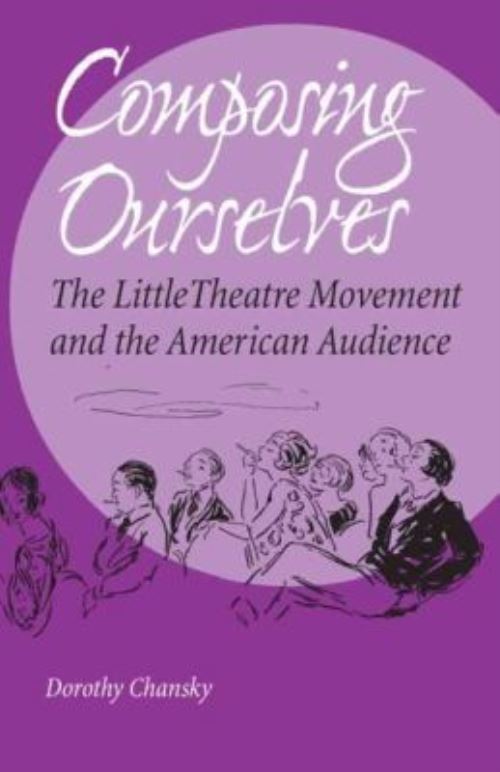
When movies replaced theatre as popular entertainment in the years 1910?20, the world of live drama was wide open for reform. American advocates and practitioners founded theatres in a spirit of anticommercialism, seeking to develop an American audience for serious theatre, mounting plays in what would today be called ?alternative spaces," and uniting for the cause an eclectic group of professors, social workers, members of women's clubs, bohemians, artists, students, and immigrants. This rebellion, called the Little Theatre Movement, also prompted and promoted the college theatre major, the inclusion of theatre pedagogy in K?12 education, prototypes for the nonprofit model, and the notion that theatre is a valuable form of self-expression.
Composing Ourselves: The Little Theatre Movement and the American Audience argues that the movement was a national phenomenon, not just the result of aspirants copying the efforts of the much-storied Provincetown Players, Washington Square Players, Neighborhood Playhouse, and Chicago Little Theatre. Going beyond the familiar histories of the best-known groups, Dorothy Chansky traces the origins of both the ideas and the infrastructures for serious theatre that are ordinary parts of the American cultural landscape today; she also investigates the gender discrimination, racism, and class insensitivity that were embedded in reformers' ideas of the ?universal" and that still trouble the rhetoric of regional, educational, and community theatre.
An important piece of revisionist history, Composing Ourselves shows how theatre reform, in keeping with other Progressive Era activism, took on corporate, conservative society, but did so in ways that were sometimes contradictory. For example, women constituted the majority of ticket buyers and the bulk of unsung labor, yet plays by women were considered inferior. Most reformers were comfortably middle class and sought change that would eliminate the anomie of modernity but not challenge their privileged positions.
Chansky deliberates on antifeminist images of women theatergoers in literature and cartoons and considers the achievements and failures of the Drama League of America, a network of women's clubs, following up with a case study of the playwright Alice Gerstenberg to point out that theatre history has not fully realized the role of women in the Little Theatre Movement. Even as women were earning the majority of degrees in newly minted theatre programs, their paths were barred to most professional work except teaching. Chansky also considers a blackface production of a play about rural African Americans, which was a step towards sympathetic portrayals of minority characters yet still a reinforcement of white upper- and middle-class perspectives.
| ISBN: | 9780809325740 |
| Publication date: | 1st July 2004 |
| Author: | Dorothy Chansky |
| Publisher: | Southern Illinois University Press |
| Format: | Hardback |
| Pagination: | 293 pages |
| Series: | Theater in the Americas |
| Genres: |
Theatre studies Individual actors and performers |
When movies replaced theatre as popular entertainment in the years 1910?20, the world of live drama was wide open for reform. American advocates and practitioners founded theatres in a spirit of anticommercialism, seeking to develop an American audience for serious theatre, mounting plays in what would today be called ?alternative spaces," and uniting for the cause an eclectic group of professors, social workers, members of women's clubs, bohemians, artists, students, and immigrants.
Composing Ourselves features in the following genres: Theatre studies, Individual actors and performers
Paperback, Hardback. Not Available.
Composing Ourselves was written by Dorothy Chansky and published by Southern Illinois University Press
Composing Ourselves has 293 pages
Yes it is part of Theater in the Americas series