

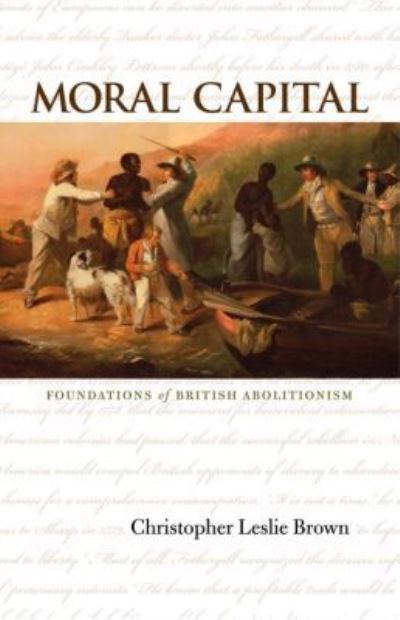
Revisiting the origins of the British antislavery movement of the late eighteenth century, Christopher Leslie Brown challenges prevailing scholarly arguments that locate the roots of abolitionism in economic determinism or bourgeois humanitarianism. Brown instead connects the shift from sentiment to action to changing views of empire and nation in Britain at the time, particularly the anxieties and dislocations spurred by the American Revolution. The debate over the political rights of the North American colonies pushed slavery to the fore, Brown argues, giving antislavery organizing the moral legitimacy in Britain it had never had before. The first emancipation schemes were dependent on efforts to strengthen the role of the imperial state in an era of weakening overseas authority. Brown connects disparate strands of the British Atlantic world and brings into focus shifting developments in British identity, attitudes toward Africa, definitions of imperial mission, the rise of Anglican evangelicalism, and Quaker activism. He shows that the abolitionist movement derived its power from a profound yearning for moral worth in the aftermath of defeat and American independence. Thus abolitionism proved to be a cause for the abolitionists themselves as much as for enslaved Africans.
| ISBN: | 9780807856987 |
| Publication date: | 30th March 2006 |
| Author: | Christopher Leslie Brown, Omohundro Institute of Early American History Culture |
| Publisher: | The University of North Carolina Press |
| Format: | Paperback |
| Pagination: | 480 pages |
| Series: | Published by the Omohundro Institute of Early American History and Culture and the University of North Carolina Press |
| Genres: |
European history History of religion Social discrimination and social justice |
Revisiting the origins of the British antislavery movement of the late eighteenth century, Christopher Leslie Brown challenges prevailing scholarly arguments that locate the roots of abolitionism in economic determinism or bourgeois humanitarianism. Brown instead connects the shift from sentiment to action to changing views of empire and nation in Britain at the time, particularly the anxieties and dislocations spurred by the American Revolution. The debate over the political rights of the North American colonies pushed slavery to the fore, Brown argues, giving antislavery organizing the moral legitimacy in Britain it had never had before. The first emancipation schemes were dependent on efforts to strengthen the role of the imperial state in an era of weakening overseas authority. Brown connects disparate strands of the British Atlantic world and brings into focus shifting developments in British identity, attitudes toward Africa, definitions of imperial mission, the rise of Anglican evangelicalism, and Quaker activism. He shows that the abolitionist movement derived its power from a profound yearning for moral worth in the aftermath of defeat and American independence. Thus abolitionism proved to be a cause for the abolitionists themselves as much as for enslaved Africans.
Moral Capital features in the following genres: European history, History of religion, Social discrimination and social justice
Moral Capital is available in Paperback
Moral Capital was written by Christopher Leslie Brown, Omohundro Institute of Early American History Culture and published by The University of North Carolina Press
Moral Capital has 480 pages