

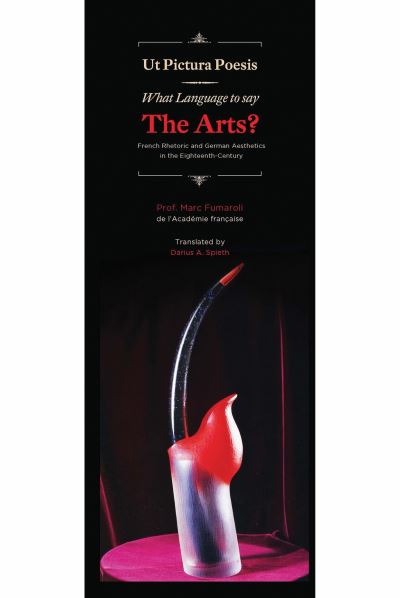
Taking its cue from Horace's saying ""As is painting, so is poetry"" (""Ut pictura poesis""), Marc Fumaroli's treatise What Language to Say the Arts? revisits the genesis of the ""conceptual turn"" in art. Fumaroli argues that the roots of this transition run deeper than the twentieth-century conceptualism of Marcel Duchamp and Andy Warhol.
Rather, the origins of conceptual art can be found in the emergence of aesthetics as a distinct branch of philosophy in eighteenth-century Germany, a time when writers, such as Lessing, Baumgarten, Winckelmann, and Kant, tried to analyze art from a purely intellectual perspective.
These thinkers positioned themselves in opposition to another, older school of thought based on a poetic approach to the appreciation of art that harkens back to classical antiquity. Fumaroli contends that this classical tradition's emphasis on pleasure and the sensual enjoyment of art is better suited than high-minded intellectualism to close the perceived gap between artistic practice and language.
| ISBN: | 9780807164150 |
| Publication date: | 22nd February 2016 |
| Author: | Marc Fumaroli |
| Publisher: | LSU Press |
| Format: | Paperback |
| Pagination: | 72 pages |
| Genres: |
History of art |
Fumaroli argues that the roots of this transition run deeper than the twentieth-century conceptualism of Marcel Duchamp and Andy Warhol. Rather, the origins of conceptual art can be found in the emergence of aesthetics as a distinct branch of philosophy in eighteenth-century Germany, a time when writers, such as Lessing, Baumgarten, Winckelmann, and Kant, tried to analyze art from a purely intellectual perspective.
What Language to Say the Arts? features in the following genres: History of art
Paperback. £13.49, down from the £14.99 cover price. Not Available.
What Language to Say the Arts? was written by Marc Fumaroli and published by LSU Press
What Language to Say the Arts? has 72 pages
£13.49, reduced from £14.99. Not Available.