

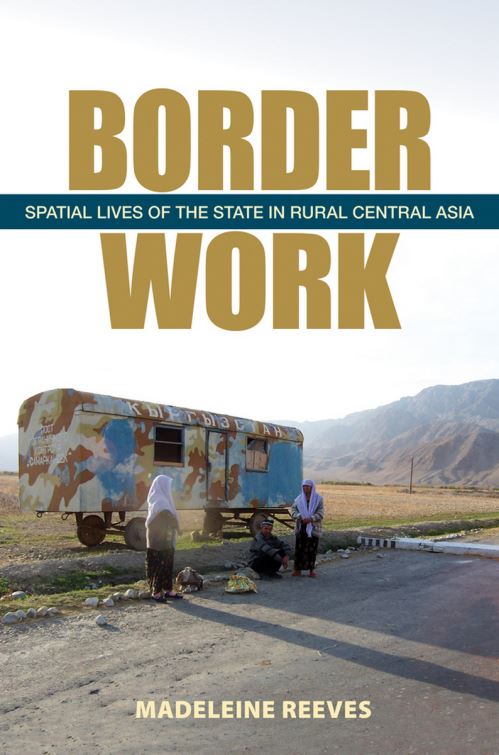
Drawing on extensive and carefully designed ethnographic fieldwork in the Ferghana Valley region, where the state borders of Kyrgyzstan, Tajikizstan and Uzbekistan intersect, Madeleine Reeves develops new ways of conceiving the state as a complex of relationships, and of state borders as socially constructed and in a constant state of flux. She explores the processes and relationships through which state borders are made, remade, interpreted and contested by a range of actors including politicians, state officials, border guards, farmers and people whose lives involve the crossing of the borders. In territory where international borders are not always clearly demarcated or consistently enforced, Reeves traces the ways in which states' attempts to establish their rule create new sources of conflict or insecurity for people pursuing their livelihoods in the area on the basis of older and less formal understandings of norms of access. As a result the book makes a major new and original contribution to scholarly work on Central Asia and more generally on the anthropology of border regions and the state as a social process. Moreover, the work as a whole is presented in a lively and accessible style. The individual lives whose tribulations and small triumphs Reeves so vividly documents, and the relationships she establishes with her subjects, are as revealing as they are engaging. Border Work is a well-deserved winner of this year's Alexander Nove Prize.
| ISBN: | 9780801477065 |
| Publication date: | 15th April 2014 |
| Author: | Madeleine Reeves |
| Publisher: | Cornell University Press |
| Format: | Paperback |
| Pagination: | 312 pages |
| Series: | Culture and Society After Socialism |
| Genres: |
Social and cultural anthropology Rural communities Asian history Human geography |
Drawing on extensive and carefully designed ethnographic fieldwork in the Ferghana Valley region, where the state borders of Kyrgyzstan, Tajikizstan and Uzbekistan intersect, Madeleine Reeves develops new ways of conceiving the state as a complex of relationships, and of state borders as socially constructed and in a constant state of flux. She explores the processes and relationships through which state borders are made, remade, interpreted and contested by a range of actors including politicians, state officials, border guards, farmers and people whose lives involve the crossing of the borders. In territory where international borders are not always clearly demarcated or consistently enforced, Reeves traces the ways in which states' attempts to establish their rule create new sources of conflict or insecurity for people pursuing their livelihoods in the area on the basis of older and less formal understandings of norms of access. As a result the book makes a major new and original contribution to scholarly work on Central Asia and more generally on the anthropology of border regions and the state as a social process. Moreover, the work as a whole is presented in a lively and accessible style. The individual lives whose tribulations and small triumphs Reeves so vividly documents, and the relationships she establishes with her subjects, are as revealing as they are engaging. Border Work is a well-deserved winner of this year's Alexander Nove Prize.
Border Work features in the following genres: Social and cultural anthropology, Rural communities, Asian history, Human geography
Border Work is available in Paperback, Hardback, Ebook
Border Work was written by Madeleine Reeves and published by Cornell University Press
Border Work has 312 pages
Yes it is part of Culture and Society After Socialism series
£21.59