

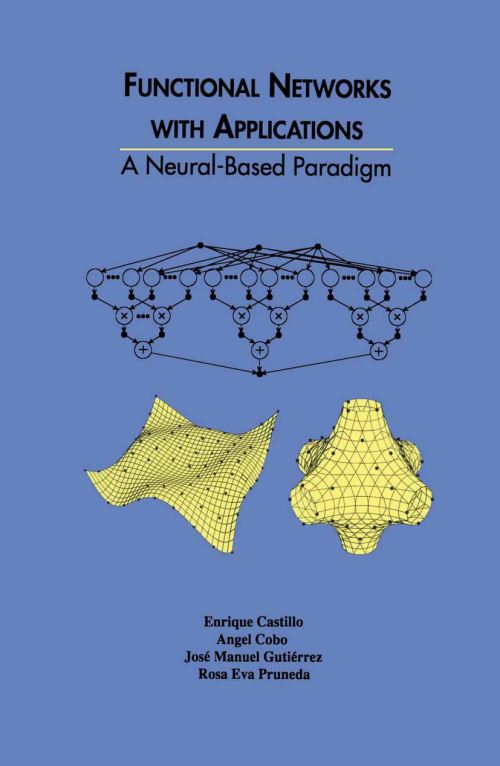
Artificial neural networks have been recognized as a powerful tool to learn and reproduce systems in various fields of applications. Neural net- works are inspired by the brain behavior and consist of one or several layers of neurons, or computing units, connected by links. Each artificial neuron receives an input value from the input layer or the neurons in the previ- ous layer.
Then it computes a scalar output from a linear combination of the received inputs using a given scalar function (the activation function), which is assumed the same for all neurons. One of the main properties of neural networks is their ability to learn from data. There are two types of learning: structural and parametric.
Structural learning consists of learning the topology of the network, that is, the number of layers, the number of neurons in each layer, and what neurons are connected. This process is done by trial and error until a good fit to the data is obtained. Parametric learning consists of learning the weight values for a given topology of the network.
Since the neural functions are given, this learning process is achieved by estimating the connection weights based on the given information. To this aim, an error function is minimized using several well known learning methods, such as the backpropagation algorithm. Unfortunately, for these methods: (a) The function resulting from the learning process has no physical or engineering interpretation.
Thus, neural networks are seen as black boxes.
| ISBN: | 9780792383321 |
| Publication date: | 31st October 1998 |
| Author: | Enrique Castillo |
| Publisher: | Springer an imprint of Springer US |
| Format: | Hardback |
| Pagination: | 308 pages |
| Series: | The Kluwer International Series in Engineering and Computer Science |
| Genres: |
Cybernetics and systems theory Mathematical physics Computer-aided design (CAD) Artificial intelligence Databases |
Artificial neural networks have been recognized as a powerful tool to learn and reproduce systems in various fields of applications. Neural net- works are inspired by the brain behavior and consist of one or several layers of neurons, or computing units, connected by links.
Functional Networks With Applications features in the following genres: Cybernetics and systems theory, Mathematical physics, Computer-aided design (CAD), Artificial intelligence, Databases
Hardback. Not Available.
Functional Networks With Applications was written by Enrique Castillo and published by Springer an imprint of Springer US
Functional Networks With Applications has 308 pages
Yes it is part of The Kluwer International Series in Engineering and Computer Science series