

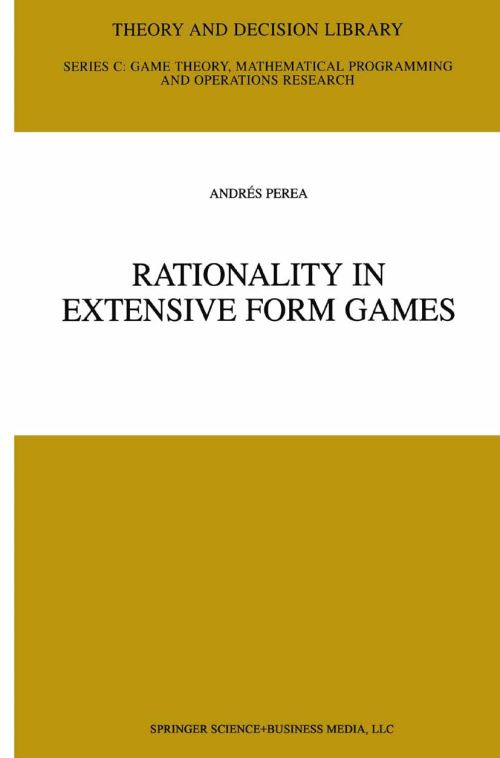
This text is concerned with situations in which several persons reach decisions independently and the final consequence depends, potentially, upon each of the decisions taken. Such situations may be described formally by an extensive form game: a mathematical object which specifies the order in which decisions are to be taken, the information available to the decision makers at each point in time, and the consequence that results for each possible combination of decisions.
A necessary requirement for rational behaviour in such games is that each decision maker should reach a decision that is optimal, given his preferences over his own decisions. This requirement is far from sufficient, however, since every decision-maker should in addition base his preferences upon the conjecture that his opponents will act optimally as well. It is this principle that distinguishes nonco-operative game theory from one-person decision theory.;The main purpose of this volume is to discuss different formalizations of this principle in extensive form games, such as backward induction, Nash equilibrium, forward induction and rationalizability, under the assumption that the decision-makers' preferences are given by subjective expected utility functions.
The various formalizations, or rationality criteria, are illustrated by examples, and the relationships among the different criteria are explored.
| ISBN: | 9780792375401 |
| Publication date: | 31st October 2001 |
| Author: | Andrés Perea |
| Publisher: | Springer an imprint of Springer US |
| Format: | Hardback |
| Pagination: | 242 pages |
| Series: | Theory and Decision Library. |
| Genres: |
Economic theory and philosophy Econometrics and economic statistics |
This text is concerned with situations in which several persons reach decisions independently and the final consequence depends, potentially, upon each of the decisions taken. Such situations may be described formally by an extensive form game: a mathematical object which specifies the order in which decisions are to be taken, the information available to the decision makers at each point in time, and the consequence that results for each possible combination of decisions.
Rationality in Extensive Form Games features in the following genres: Economic theory and philosophy, Econometrics and economic statistics
Hardback. Not Available.
Rationality in Extensive Form Games was written by Andrés Perea and published by Springer an imprint of Springer US
Rationality in Extensive Form Games has 242 pages
Yes it is part of Theory and Decision Library. series