

Speakers can get to know the meaning of any of indefinitely many sentences that they have never heard before. This statement encapsulates the problem of linguistic creativity, which lies at the core of philosophy of language and theoretical linguistics. It has also sparked off a considerable amount of work on the philosophy of mind.
After establishing the failure of the familiar compositional approach to the problem, the book adopts a radically new start. It develops core elements of the later Wittgenstein's conception of philosophy, putting them to work to`dissolve' the problem, proving it ill-framed by clarifying the questions posing it and breaking the spell of mistaken analogies that inform it.
This sharply focused monograph thus has a dual aim: coping with a crucial problem that turns out to be a lot tougher than is generally supposed, and presenting a precise and rigorous demonstration of an unfamiliar and exciting philosophical approach.
Audience: Clearly written and lucidly structured, the book addresses professional philosophers and advanced undergraduates alike.
| ISBN: | 9780792361244 |
| Publication date: | 29th February 2000 |
| Author: | Eugen Fischer |
| Publisher: | Springer an imprint of Springer Netherlands |
| Format: | Hardback |
| Pagination: | 193 pages |
| Series: | Philosophical Studies Series |
| Genres: |
Philosophy of language Philosophy: epistemology and theory of knowledge Philosophy of mind Linguistics |
Speakers can get to know the meaning of any of indefinitely many sentences that they have never heard before. This statement encapsulates the problem of linguistic creativity, which lies at the core of philosophy of language and theoretical linguistics.
Linguistic Creativity features in the following genres: Philosophy of language, Philosophy: epistemology and theory of knowledge, Philosophy of mind, Linguistics
Hardback. Not Available.
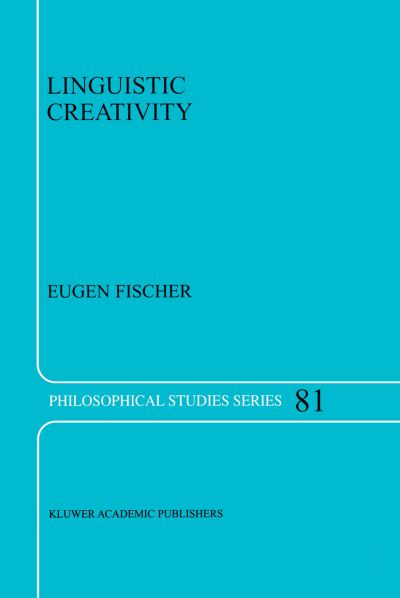
Linguistic Creativity was written by Eugen Fischer and published by Springer an imprint of Springer Netherlands
Linguistic Creativity has 193 pages
Yes it is part of Philosophical Studies Series series